

10 minutes
Claude Changed Who Builds Software. Now Enterprises Must Learn to Operate What Gets Built.
David Greenberg
Chief Marketing Officer
In our previous article, we explored how Claude quietly became much more than an AI assistant. Through Claude Code, Projects, Artifacts, and an increasingly rich ecosystem for building, Claude has evolved into one of the most accessible platforms for creating software, automating business processes, and solving problems that once required dedicated engineering teams.
That shift is no longer theoretical. It's already happening inside enterprises.
But as often happens with technology, the biggest transformation isn't the one everyone is talking about.
For the past 2 years, enterprise AI conversations have largely centered on models. Organizations compare benchmarks, debate reasoning capabilities, evaluate pricing, and speculate about which provider is best positioned to win the AI race. Those discussions matter, but they're increasingly focused on the engine instead of the journey.
The more profound shift isn't happening inside the models themselves. It's happening inside the organizations using them.
Every week, more people are becoming builders.
Not because they've decided to become software engineers, but because the tools have fundamentally changed what it means to build.
For decades, creating software required specialized skills, dedicated development teams, and lengthy implementation cycles. Ideas moved slowly because they had to pass through organizations already constrained by engineering capacity. The number of people capable of creating technology was naturally limited.
AI is quietly removing that limitation.
Today, a marketing manager can build an AI-powered campaign assistant. A RevOps leader can automate pipeline management. An analyst can create an internal research tool tailored to a specific business problem. An operations team can eliminate hours of manual work with a workflow assembled in an afternoon.
None of these people suddenly became software developers.
They simply became capable of building.
That distinction may prove to be one of the most important technology shifts of the decade.
The Builder Population Is Expanding
Looking back over the last fifty years of enterprise computing, every major platform expanded who could create value.
The personal computer brought computing to individuals. The web gave organizations global reach. Cloud computing made infrastructure accessible. Low-code platforms enabled business users to create applications without writing traditional software.
AI appears to be doing something different.
Rather than simply making professional developers more productive, it is dramatically increasing the number of people capable of creating software-like solutions in the first place.
McKinsey recently estimated that sales and marketing account for 28% of generative AI's economic potential—slightly ahead of software engineering at 25%. That finding says something much larger than "marketing likes AI."
It suggests that software creation itself is becoming more broadly distributed.
Increasingly, the people closest to business problems are also becoming the people capable of solving them.
That changes the economics of innovation.
For years, building something new usually meant waiting for engineering resources, roadmap prioritization, development cycles, and someone else to fully understand the problem before a solution could even begin.
Today, that distance has collapsed.
What once required weeks or months can increasingly happen in a single afternoon. This may ultimately explain Claude's momentum inside the enterprise better than any benchmark ever could.
Claude creates more builders. More builders should produce more innovation. More experimentation. More localized problem solving. More software created by the people who understand the business best.
Most organizations would happily accept that outcome.
But every major platform shift eventually reaches a second phase.
The first phase makes creation easier. The second makes management harder.
Cloud computing didn't simply simplify infrastructure. It created Cloud Operations. Continuous software delivery didn't just accelerate releases. It fundamentally reshaped DevOps.
Every successful technology platform eventually moves the bottleneck.
AI is approaching that moment now.
The Bottleneck Has Moved
As AI-native builders multiply across the enterprise, success begins creating its own complexity. The marketing workflow that started as an experiment is now generating qualified pipeline. The operations automation quietly becomes part of a critical business process. An internal research assistant starts influencing executive decisions. What began as individual productivity slowly evolves into enterprise infrastructure.
That's how important software has always entered organizations. It rarely arrives with a grand announcement. Instead, it solves one problem well enough that people begin relying on it. Over time, what started as an experiment becomes part of the way the business operates.
AI-native systems are following exactly the same path—only much faster.
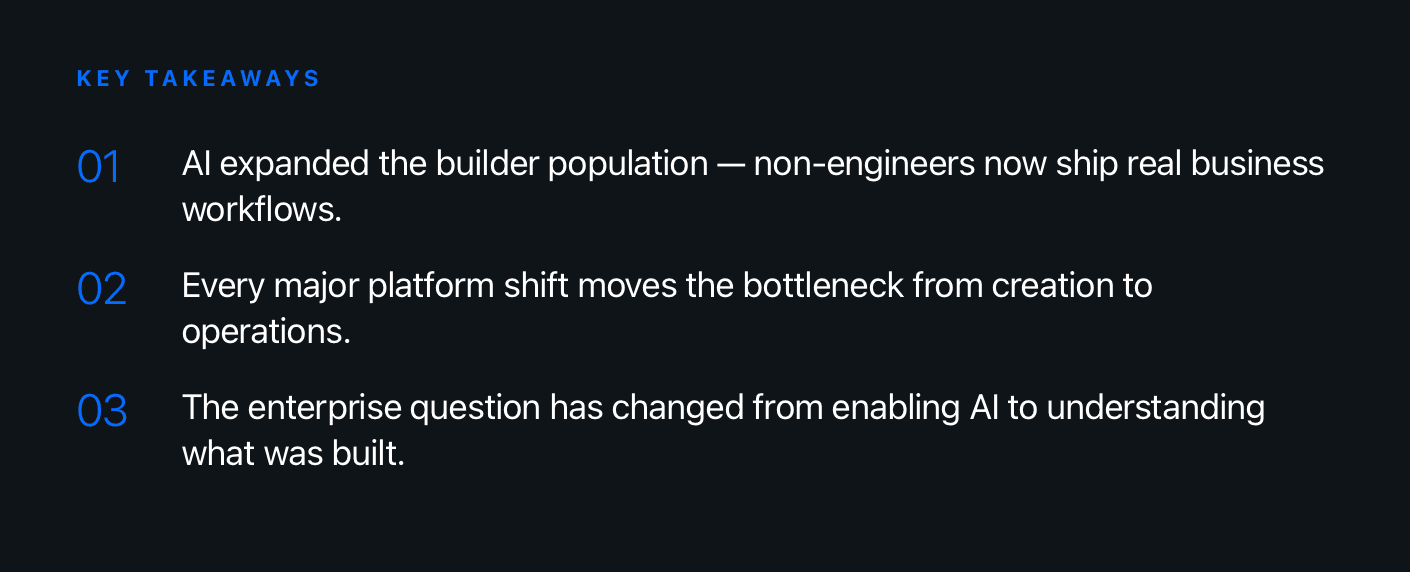
As a result, the enterprise conversation begins to change. It becomes less about enabling people to build and increasingly about understanding what has been built.
The questions leaders ask reflect that shift. Rather than focusing on introducing AI, they begin asking how to support a rapidly growing population of builders. Where are teams creating AI-powered workflows? Which of those workflows have become business critical? How much AI infrastructure is now supporting day-to-day operations? And how do successful experiments mature into trusted business capabilities?
Notice how different those questions are.
For the first time, enterprises aren't simply managing applications created by engineering teams. They're supporting an expanding ecosystem of AI-native builders who continuously create, refine, and improve intelligent systems across every part of the business.
The Next Chapter
When we published the first article in this series, our central observation was that Claude had quietly become an enterprise platform.
The larger realization may be that it has also quietly moved the enterprise bottleneck.
For decades, organizations struggled to create software. Today, software is becoming dramatically easier to create. The harder challenge is understanding, supporting, and operating everything that follows.
That doesn't diminish the importance of AI. If anything, it amplifies it.
Because the easier it becomes for thousands of people to build intelligent systems, the more important it becomes to create an environment where those systems can grow, evolve, and ultimately become trusted parts of the business.
We believe that marks the beginning of a new operational discipline.
In our next article, we'll introduce that discipline and explore why we believe
FAQ
What does it mean that AI is expanding the builder population in enterprises?
Historically, building software required specialized engineering skills and dedicated development teams. AI tools like Claude have changed that — marketing managers, RevOps leaders, analysts, and operations teams can now create functional workflows and automations without writing traditional code. The number of people capable of producing software-like solutions inside an enterprise is growing rapidly, and those builders are distributed across every business function, not concentrated in engineering.
Why is operating AI systems harder than enabling people to build them?
Enabling AI is largely a tooling and access problem — give people the right tools and they build. Operating AI is an organizational problem: understanding what has been built, which workflows have become business-critical, how much AI infrastructure now supports day-to-day operations, and how experiments mature into trusted capabilities. Every major platform shift — cloud, DevOps, platform engineering — followed the same pattern: creation got easier, then management got harder. AI is reaching that same inflection point.
How does AI-native software enter enterprises differently from traditional software?
Traditional enterprise software typically arrives through formal procurement, IT review, and planned rollouts. AI-native workflows tend to enter informally — someone solves a specific problem, others start relying on it, and what began as an experiment quietly becomes part of how the business operates. The same pattern has always applied to important software, but AI accelerates the timeline dramatically. A workflow built in an afternoon can become critical infrastructure within weeks.
What's the difference between AI adoption and AI operations in an enterprise?
AI adoption focuses on whether employees can use AI productively — which models to standardize on, where AI delivers ROI, how to get people started. AI operations is what comes after adoption succeeds: understanding the full inventory of AI-native systems running across the business, maintaining visibility into what those systems actually do at runtime, managing costs as agent usage scales, and ensuring that workflows built by distributed teams meet the reliability and governance standards required for business-critical use.
What is the enterprise bottleneck that AI has moved?
For decades, the bottleneck in enterprise software was creation — not enough engineers, not enough capacity, ideas waiting in queues. AI is removing that constraint by enabling non-engineers to build. But as creation accelerates, a new bottleneck emerges: operations. Organizations now need visibility into what has been built across hundreds of builders, which systems are business-critical, and how to support and govern an expanding ecosystem of AI-native workflows they didn't commission through traditional channels.
Claude didn't just change how people build software. It changed who gets to build it. As AI-native builders spread across every part of the enterprise, organizations are discovering that enabling AI is only the beginning. The next challenge is learning how to operate it.
