

5 minutes
How Claude Has Become The Enterprise AI Platform
David Greenberg
Chief Marketing Officer
Enterprise AI discussions often focus on models.
Organizations compare benchmarks, evaluate capabilities, review pricing, and debate which provider is best positioned to support their AI strategy. While those conversations are understandable, they increasingly miss the most important shift happening inside enterprises today.
The real story is not about models.
It is about builders.
Claude Is Becoming An Operating Environment
Over the past year, Claude has evolved from a conversational assistant into something much more significant. Through Projects, Artifacts, Claude Code, and the rapidly expanding Model Context Protocol (MCP) ecosystem, Claude has become one of the most accessible environments for creating software, workflows, automations, and business solutions.

Most organizations have not fully recognized what that means.
When executives discuss AI adoption, they often measure success through productivity gains. Employees spend less time writing content, conducting research, or performing repetitive tasks. Those benefits are real, but they only represent the first phase of adoption.
The more important change is that people who never considered themselves software builders are increasingly creating technology. Marketing leaders are building campaign automation. Operations teams are creating workflow systems. Product managers are generating internal applications. Analysts are developing research tools tailored to specific business needs.
Historically, these projects would have required engineering resources, development cycles, and organizational prioritization.
Today, many can be created directly by the people closest to the problem.
THE RISE OF THE AI-NATIVE BUILDER
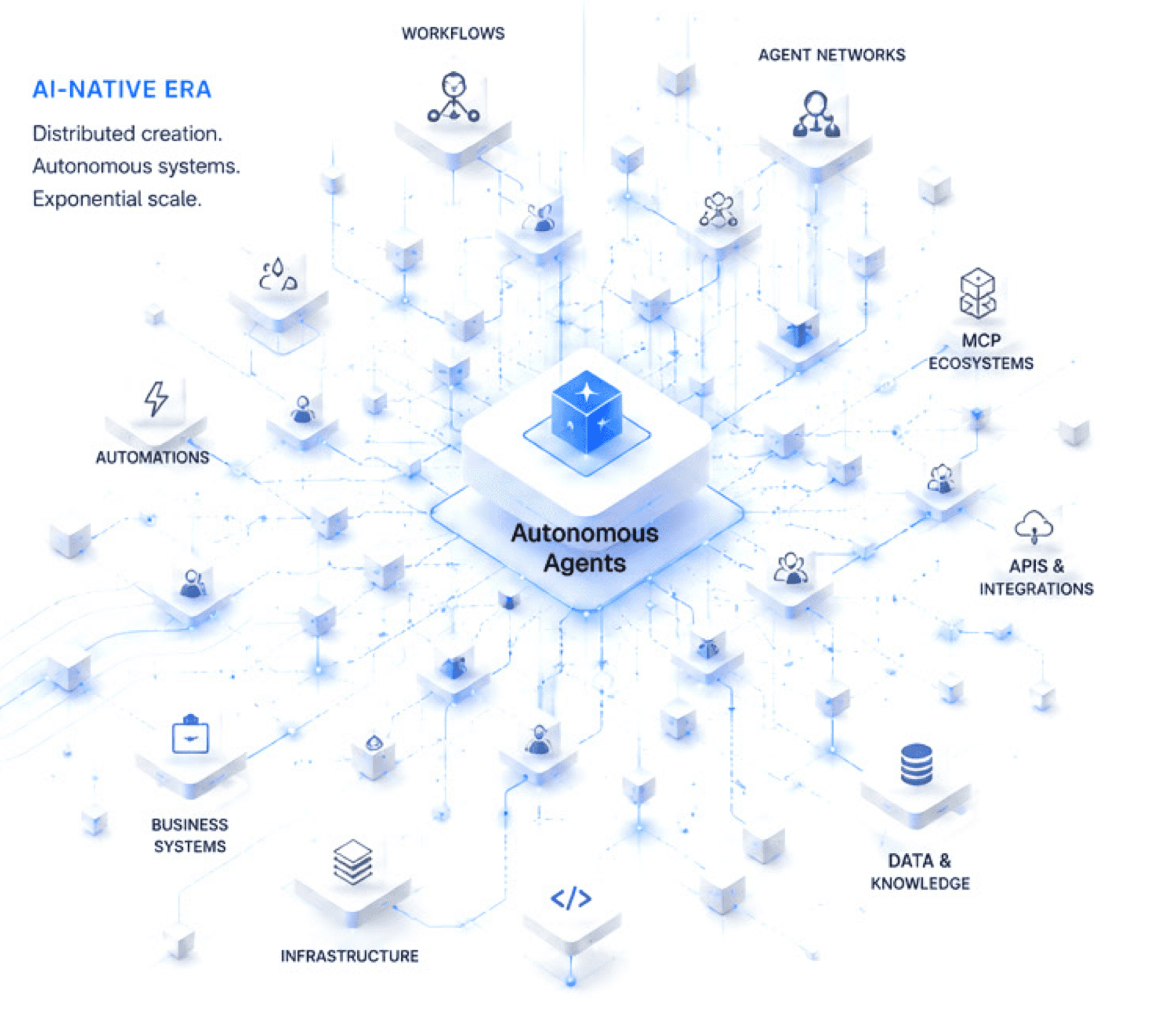
This is one reason Claude has gained such momentum inside enterprises. It empowers a rapidly growing population of AI-native builders to turn ideas into working software, workflows, and automations with unprecedented speed.
A domain expert no longer needs to translate business requirements through multiple layers of technical teams before something useful can be built. They can often move directly from concept to implementation.
The introduction of Claude Code has accelerated software creation. Projects provide persistent working environments. Artifacts enable interactive applications. MCP enables access to tools, services, and systems that extend Claude beyond a standalone model.
Taken together, these capabilities create something fundamentally different from the first generation of AI assistants. They create an environment where builders can create, test, iterate, and deploy solutions rapidly.
WHY MCP CHANGES EVERYTHING
The emergence of MCP has accelerated this trend dramatically.
Rather than functioning as an isolated AI assistant, Claude can increasingly interact with external systems, business applications, APIs, and data sources. The result is an environment where employees are not simply generating outputs. They are orchestrating actions.
That distinction matters.
A workflow that connects CRM data, customer communications, internal documentation, and analytics systems is no longer functioning as a chatbot. It is functioning as part of a business process.
As MCP adoption grows, Claude increasingly becomes the connective tissue between knowledge, systems, and action.
Enterprise Implications of Distributed Creation
For decades, software creation operated through centralized development organizations. Every application, integration, or automation competed for limited engineering capacity.
Claude changes that equation.
The emergence of AI-native builders is fundamentally expanding the number of people capable of creating value through software. Potential benefits include:
Faster innovation cycles
Reduced development bottlenecks
Greater experimentation
More localized problem solving
Increased organizational agility
For enterprises pursuing AI transformation, this may become one of the most important competitive advantages.
The organizations creating the greatest value from AI are not necessarily those deploying the most advanced models. They are increasingly the organizations enabling the largest number of effective builders.
What Happens When Everyone Can Build
Yet as more employees begin creating AI-powered systems, workflows, and automations, organizations must eventually answer a different set of questions.
How many of these systems exist?
What are they connected to?
How are they operating?
Who owns them?
What data are they accessing?
What costs are they generating?
At first, those questions seem secondary. Over time, they become essential.
Every major technology transition eventually reaches a point where creation becomes easier than management. Claude is beginning to create a similar challenge inside the enterprise.
The organizations that recognize this shift early will gain significant advantages. They will not simply enable more builders. They will develop the operational maturity required to support them.
Because while the rise of AI-native builders may be one of the most important trends in enterprise technology, understanding what those builders create may ultimately prove just as important.
FAQ
What is the difference between Claude as an AI assistant and Claude as an enterprise platform?
As an AI assistant, Claude generates outputs — text, summaries, code snippets — in response to prompts. As an enterprise platform, Claude enables employees to build persistent workflows, interactive applications, and automated systems that connect to external tools and business data via MCP. The distinction is between generating content and orchestrating actions across business systems.
What is Model Context Protocol (MCP) and why does it matter for enterprises?
MCP is a protocol that allows Claude to connect to external systems, APIs, databases, and business applications. Instead of operating as a standalone assistant, Claude can read from CRMs, trigger workflows, query data sources, and interact with internal tools. This transforms Claude from a content generator into an active participant in business processes.
What is an AI-native builder?
An AI-native builder is a domain expert — a marketing leader, operations manager, or product analyst — who uses tools like Claude to create working software, automations, or workflows without relying on a traditional engineering team. Claude lowers the barrier between having an idea and shipping a functional solution, enabling non-engineers to build directly.
Why do existing IT monitoring and security tools fall short for Claude-powered environments?
Traditional monitoring tools were built for applications and infrastructure. Security tools were built for known threat patterns. Neither was designed for environments where AI models dynamically interact with tools, APIs, and business systems across distributed execution paths. In Claude-powered environments, behavior is emergent and context-dependent — understanding an execution path requires a different operational layer than understanding an application or a server.
What is Agentic Operations and why are enterprises adopting it?
Agentic Operations is an emerging discipline for managing AI-native systems at scale. As employees build Claude-powered workflows that span multiple tools, APIs, and data sources, traditional IT monitoring and security tools cannot answer basic questions: what systems exist, what actions are being taken, what data is being accessed, and who owns what. Agentic Operations fills that gap with visibility, context, and governance designed for autonomous AI behavior.
