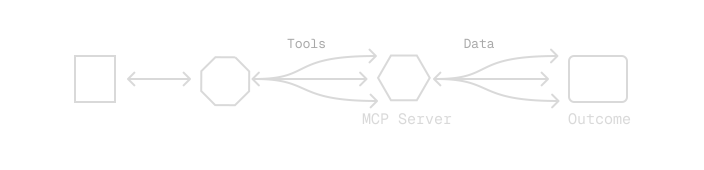
Agents create new control challenges at runtime.

BlueRock gives security teams the visibility and guardrails needed to understand agent behavior, guide execution as it happens, and reduce risk without slowing development.

Secured MCP Servers for Customers

As an agentic AI company, Adspirer powers AI performance marketing agents that plan, launch, and optimize campaigns across Meta, Google, and more. With thousands of decisions flowing through our MCP infrastructure, our customers expect reliability and security. BlueRock gives us the visibility and control we need to run agentic systems with confidence.

Abhi Mekala

CEO of Adspirer

Secured MCP Servers for Customers

As an agentic AI company, Adspirer powers AI performance marketing agents that plan, launch, and optimize campaigns across Meta, Google, and more. With thousands of decisions flowing through our MCP infrastructure, our customers expect reliability and security. BlueRock gives us the visibility and control we need to run agentic systems with confidence.

Abhi Mekala

CEO of Adspirer

Secured MCP Servers for Customers

As an agentic AI company, Adspirer powers AI performance marketing agents that plan, launch, and optimize campaigns across Meta, Google, and more. With thousands of decisions flowing through our MCP infrastructure, our customers expect reliability and security. BlueRock gives us the visibility and control we need to run agentic systems with confidence.

Abhi Mekala

CEO of Adspirer

Problems

You Can’t See What Actually Happened

You need to understand how agent behavior unfolds in production. Instead, execution is fragmented across tools, MCP servers, and services with no clear view of what actually occurred.

You Can’t Understand What Was Invoked

You need to know which tools, MCP servers, and capabilities were involved in each action. Instead, logs and traces lack the context needed to evaluate what agents are actually doing.

You Can’t Reliably Control Execution

You need to apply policies when actions occur. Instead, controls operate before execution, leaving runtime behavior ungoverned as agents dynamically generate execution paths.

You Can’t Contain Risk as Behavior Propagates

You need to limit blast radius as agents interact with tools and MCP servers. Instead, over-permissioned components and unclear usage create hidden exposure across environments.

How BlueRock Solves

Execution-Level Observability

Understand how agent decisions translate into actions across tools, MCP servers, and connected components — so security teams can see what actually happened in production.

Trust Context at Every Step

Each step is enriched with identifiers, capability metadata, ownership signals, and runtime behavior — giving teams the context needed to evaluate what agents are invoking and whether those components should be used.

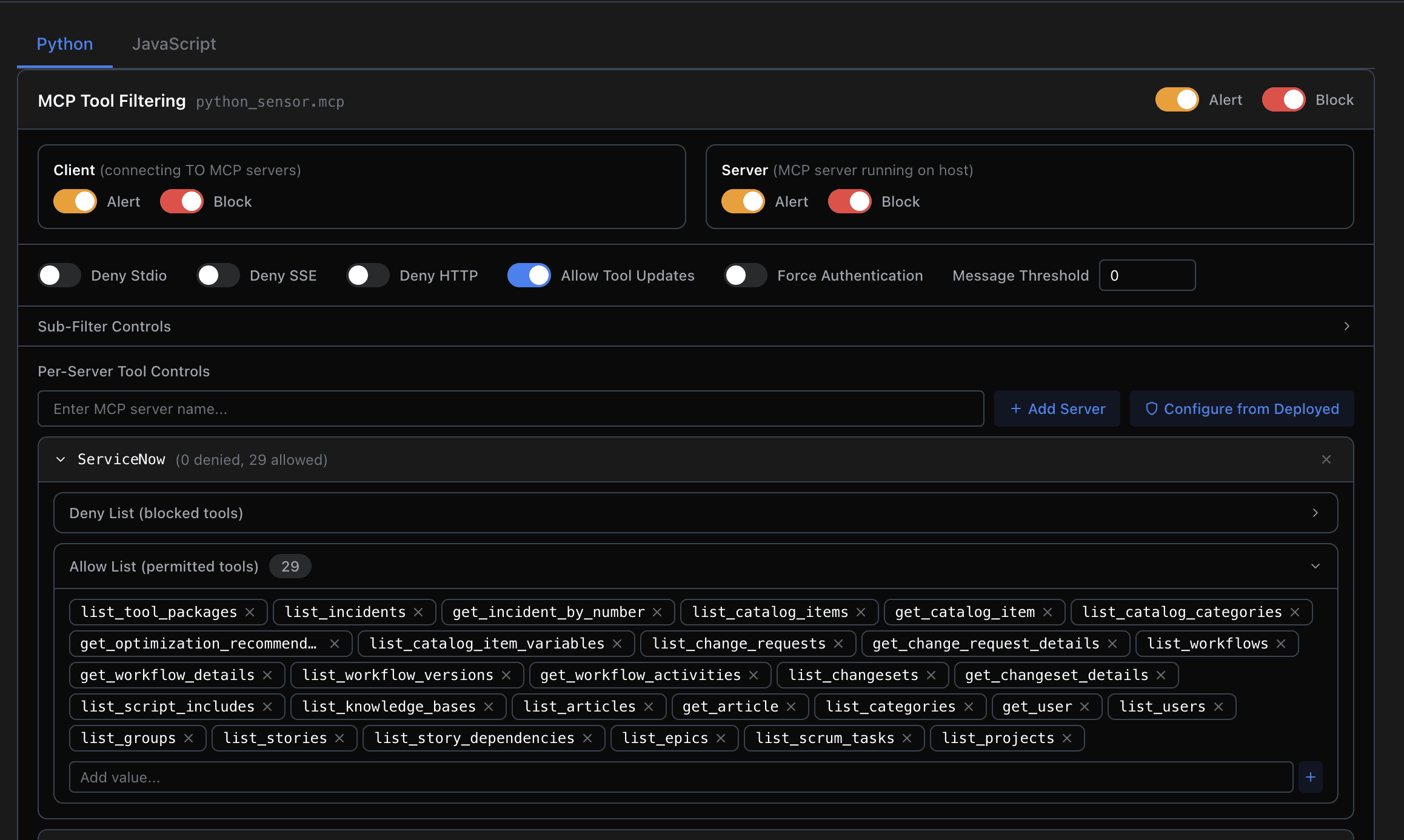
Context-Aware Guardrails

Apply policies using the actual tools, components, and behavior involved in execution — so control happens when actions occur, not just before they begin.

Execution Graph Visualization

See how actions propagate across tools, MCP servers, and downstream components in a connected view — making blast radius, dependency paths, and unexpected behavior easier to contain.

Single Source of Runtime Truth

Maintain a unified, audit-ready record of execution across systems.

"We don’t need more alerts—we need control at the moment an agent turns a decision into action."

"We don’t need more alerts—we need control at the moment an agent turns a decision into action."

Start Building With BlueRock

Start Building With BlueRock

Start Building With BlueRock

Common Questions

For Security Operations and Application Security Teams

What visibility does BlueRock give security teams into agent behavior?

BlueRock provides intent-level visibility across the full Agentic Action Path, not just request logs or prompt traces. Security teams can see which agents ran, which MCP servers and tools they called, what data they accessed, how execution propagated across systems, and whether the trust posture of each interaction was within policy. This is the context needed to assess risk accurately — and to enforce without over-blocking.

How do Guardrails enforce policy without slowing development teams?

BlueRock Guardrails use the Trust Context Engine to make enforcement decisions based on agent identity, capability scope, and MCP server trust posture, not broad pattern matching. This precision means policies can be defined tightly around actual risk behaviors, leaving legitimate agent operations unaffected. Developers don't encounter friction unless an action falls outside defined scope.

How does BlueRock handle MCP server risk?

The MCP Trust Registry evaluates public and private MCP servers across 22+ security rules, covering tool exposure, SSRF, command injection, supply chain vulnerabilities, and authentication gaps. Security teams can use Trust Registry ratings to establish policy about which MCP servers agents can connect to, and receive alerts when servers used in production change their risk posture.

How is BlueRock different from prompt-level security controls?

Prompt-level controls evaluate requests before agents act. BlueRock enforces at the app runtime, where agentic execution actually occurs. Agents can receive a safe-looking prompt and still trigger unauthorized tool calls, escalate permissions, or exfiltrate data. These behaviors happen after the prompt layer and are invisible to edge-layer controls. BlueRock observes and governs at the execution layer, where the actual risk surface is.

What does BlueRock provide for compliance and audit?

BlueRock provides a continuous record of agentic execution — every agent action, tool call, MCP server interaction, and outcome, connected by a durable agent identifier. This execution record supports audit workflows, compliance documentation, and incident investigation. Teams can demonstrate what agents did, why, and whether it was within policy, using the same data that powers real-time enforcement.