Trace The Full Agentic Action Path

See how agent decisions propagate across tools, MCP servers, and the systems they affect.

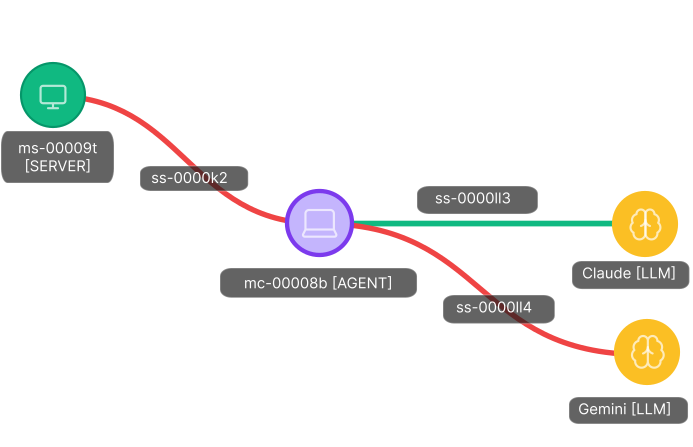
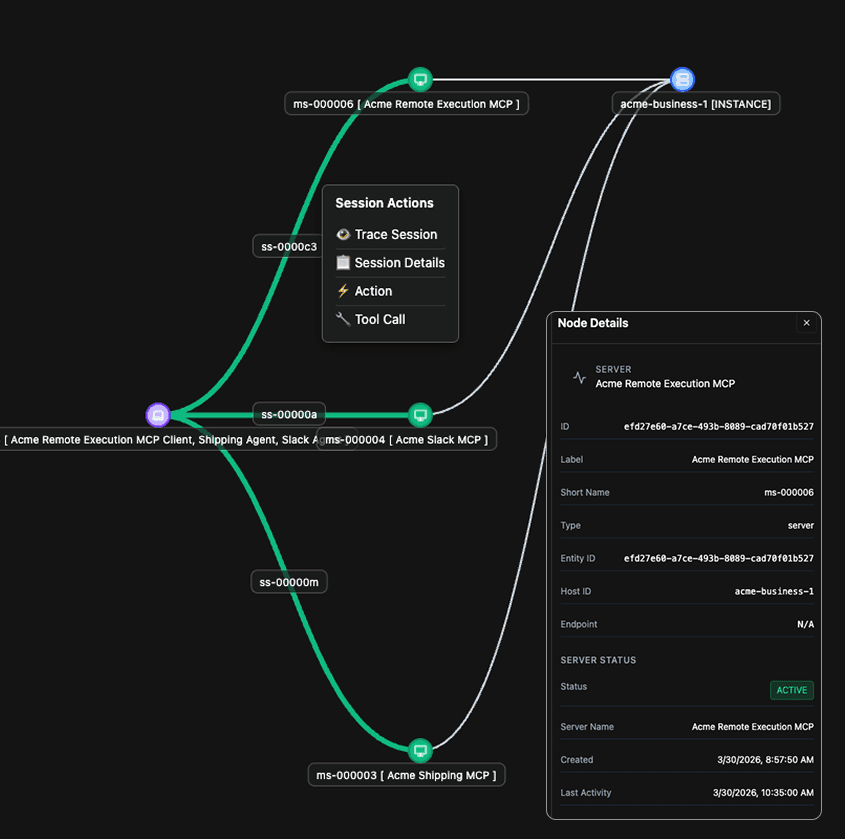
The Agentic Action Graph provides a connected view of execution across the Agentic Action Path, from agent decision to tool invocation, MCP server interaction, and downstream outcome.

This gives teams a clear way to see what ran, which tools were involved, and how behavior unfolded across connected components in real time without requiring developers to change where or how they work.
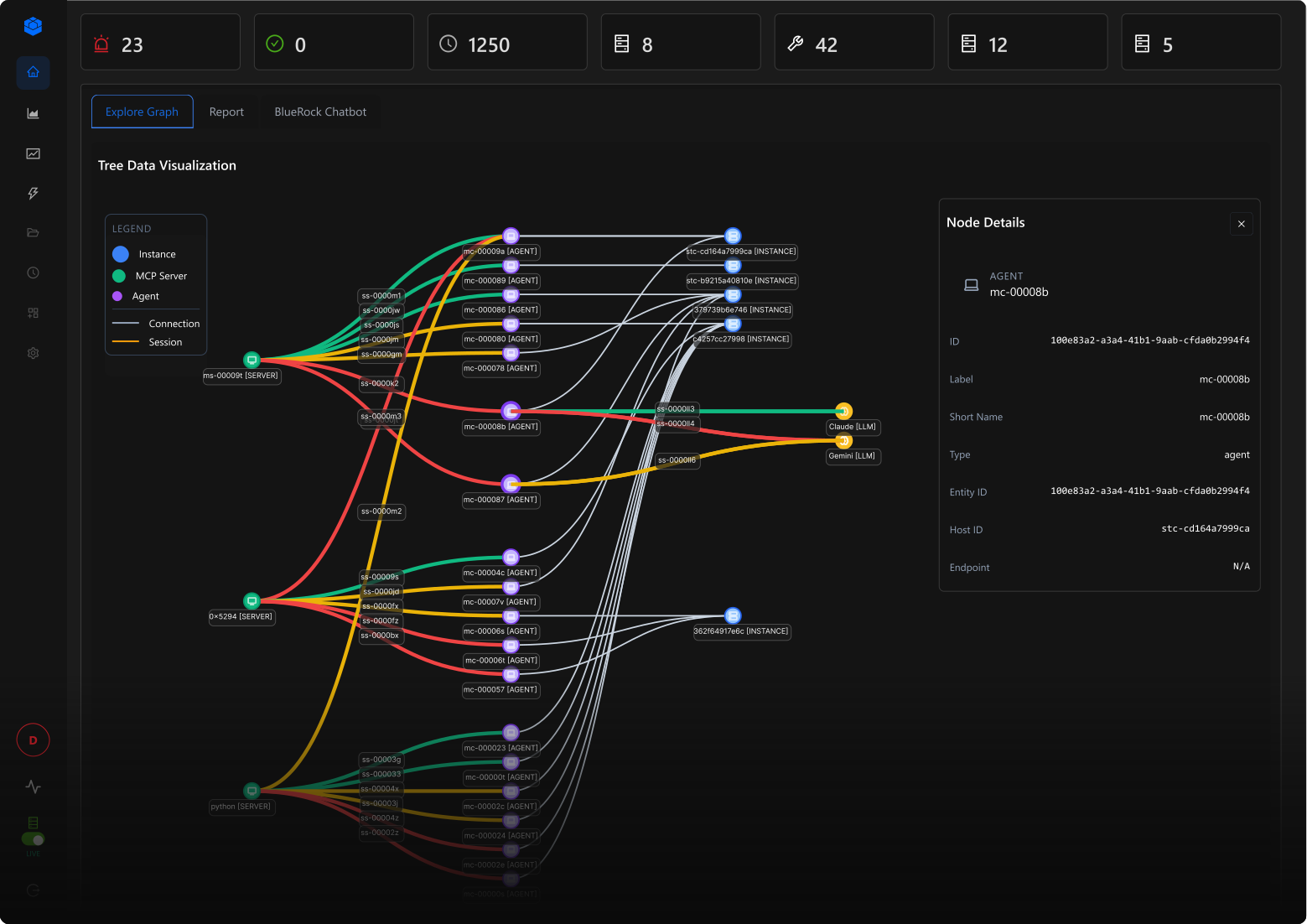
Traditional logs and traces capture isolated events. BlueRock connects those events into a single, traceable flow of execution that actions through persistent identifiers and surfacing how execution propagated across tools, MCP servers, and downstream components.

Each step is enriched with Trust Context — including capability metadata, ownership signals, and runtime behavior — so teams can understand what was involved and what was ultimately affected.

Why Agent Execution Is Hard to Understand

Agent execution now spans the full Action Path — from model output to agent decisions, tool calls, MCP server interactions, and downstream actions — but traditional observability was not built to capture that path as one connected system of behavior.

This is part of the Agentic Execution Gap. Read more ->

You Can’t See the Full Execution Path

Traditional observability captures infrastructure events, but not how agent decisions translate into tool calls, MCP server interactions, and downstream actions.

You Can’t Understand Why Actions Happened

When behavior is unexpected, teams lack the context needed to understand which tools were invoked, what capabilities were used, and why decisions were made.

You Can’t Trace How Actions Propagate

A single agent decision can trigger actions across multiple tools and MCP servers, but those effects are difficult to follow across the full execution path.

Key Capabilities

BlueRock delivers end-to-end, real-time observability of agent execution, connecting every step of the Agentic Action Path as it unfolds across models, agents, tools, MCP servers, data systems, and runtime environments.

This visibility is powered by the Trust Context Engine, which continuously enriches execution with persistent identifiers, capabilities, and trust attributes — providing the context needed to understand what agents are doing and why.

Because that context travels with execution, organizations can apply runtime guardrails that control how agents interact with real systems, enabling teams to move quickly while maintaining clarity and control over agent behavior.
Agentic Action Graph

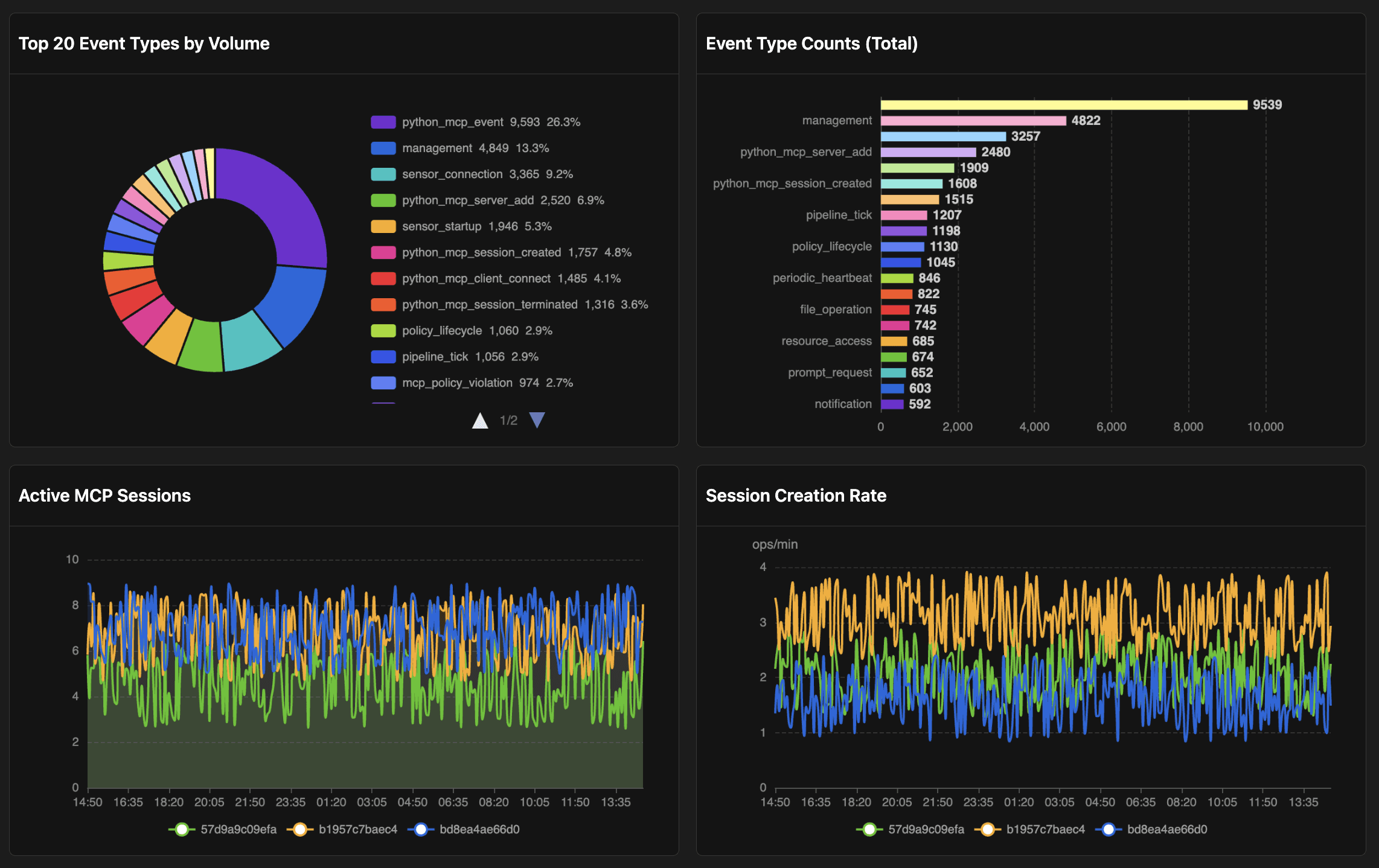
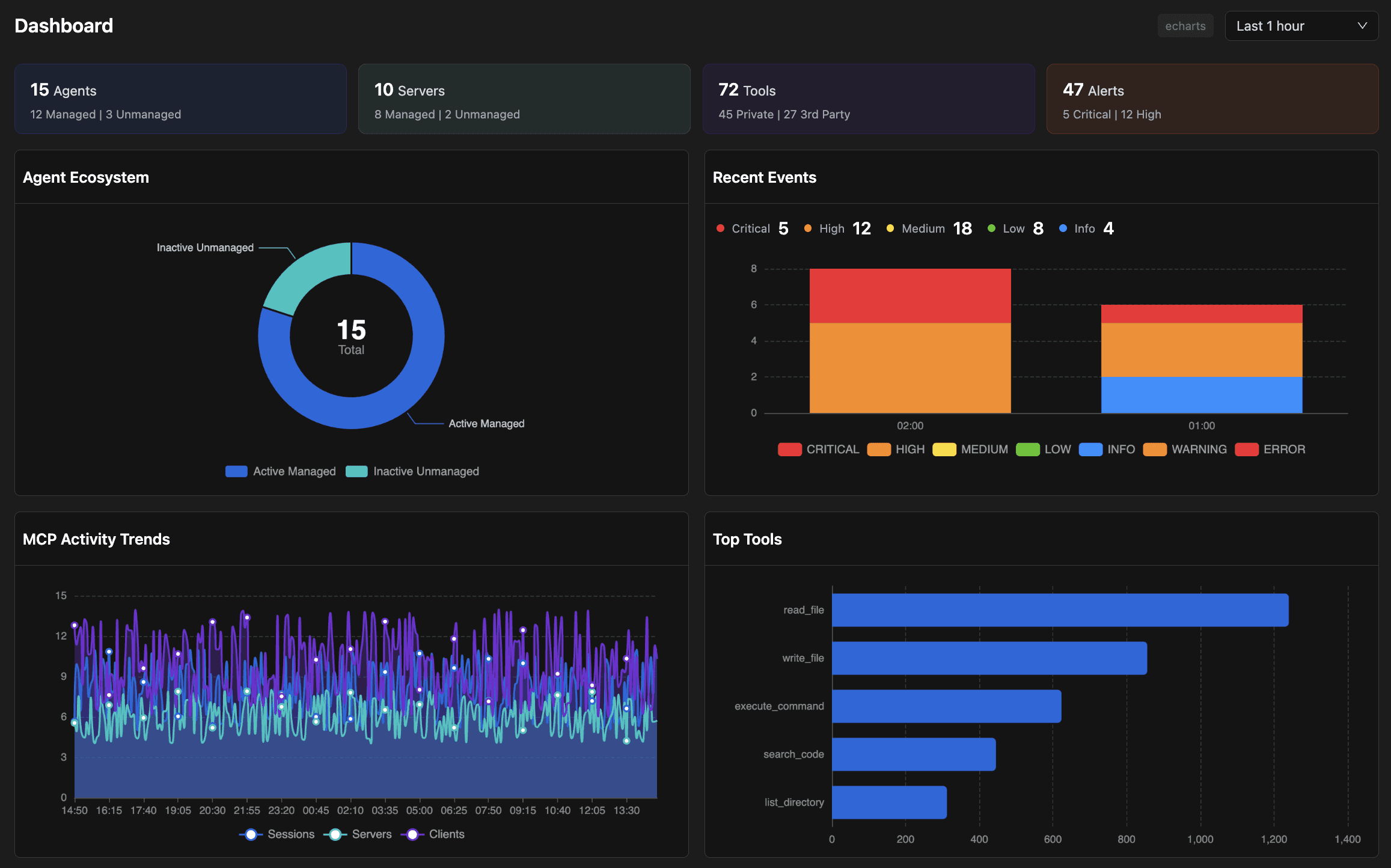
Visualize the full execution path across agents, tools, MCP servers, and downstream actions — with operational signals surfaced in one connected view. See how behavior unfolds step by step — from decision to outcome — with both graph-level tracing and dashboard-level visibility in one place.

Agentic Action Graph

Visualize the full execution path across agents, tools, MCP servers, and downstream actions — with operational signals surfaced in one connected view. See how behavior unfolds step by step — from decision to outcome — with both graph-level tracing and dashboard-level visibility in one place.

Agentic Action Graph

Visualize the full execution path across agents, tools, MCP servers, and downstream actions in a single connected view. See how behavior unfolds step by step — from decision to outcome — without switching between systems.

End-to-End Agentic Observability

Trace execution across the full Agentic Action Path, from model output through tool calls and MCP server interactions to final outcomes.

Understand what ran in production and how decisions translated into real actions.
Context-Enriched Execution Tracing

Agentic systems generate enormous amounts of execution data. BlueRock enriches every step with the context needed to understand what matters — including who initiated the action, which tools and MCP servers were involved, what was invoked, and how execution behaved. Instead of sorting through raw events alone, teams can quickly identify the runtime actions, tools, and execution paths that deserve attention.

Context-Enriched Execution Tracing

Agentic systems generate enormous amounts of execution data. BlueRock enriches every step with the context needed to understand what matters — including who initiated the action, which tools and MCP servers were involved, what was invoked, and how execution behaved. Instead of sorting through raw events alone, teams can quickly identify the runtime actions, tools, and execution paths that deserve attention.

Context-Enriched Execution Tracing

Agentic systems generate enormous amounts of execution data. BlueRock enriches every step with the context needed to understand what matters — including who initiated the action, which tools and MCP servers were involved, what was invoked, and how execution behaved. Instead of sorting through raw events alone, teams can quickly identify the runtime actions, tools, and execution paths that deserve attention.

Execution Path Correlation

Connect execution across agents, tools, MCP servers, and infrastructure into a single, traceable flow. Follow how actions propagate across components and identify where issues originate and spread.

Execution Path Correlation

Connect execution across agents, tools, MCP servers, and infrastructure into a single, traceable flow. Follow how actions propagate across components and identify where issues originate and spread.

Execution Path Correlation

Connect execution across agents, tools, MCP servers, and infrastructure into a single, traceable flow. Follow how actions propagate across components and identify where issues originate and spread.

Operational Visibility for Production Agents

Monitor agent behavior in production with a unified view of execution, usage, and system impact. Detect anomalies, track performance, and maintain reliability as agents scale.

Operational Visibility for Production Agents

Monitor agent behavior in production with a unified view of execution, usage, and system impact. Detect anomalies, track performance, and maintain reliability as agents scale.

Operational Visibility for Production Agents

Monitor agent behavior in production with a unified view of execution, usage, and system impact. Detect anomalies, track performance, and maintain reliability as agents scale.

BlueRock Captures the Full Agentic Action Path
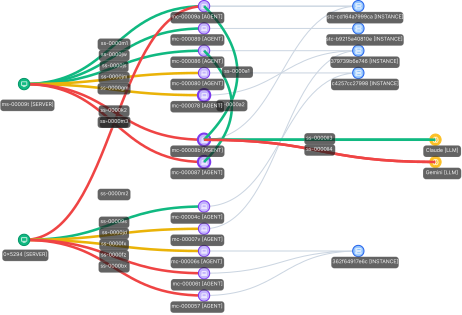
BlueRock captures execution from model output to agent decisions, tool calls, MCP server interactions, and downstream actions in a single connected view.

Each step is enriched with Trust Context — including identifiers, capability metadata, ownership signals, and runtime behavior — so teams can understand what was involved and how execution propagated.

The result is a shared operational view for AgenticOps: one place to trace behavior, understand impact, debug faster, and confidently operate agentic systems in production.

Seconds

Root cause isolation time

(vs. hours with manual log correlation)

90%

Reduction in manual

log correlation


3

Execution boundaries traced

end to end: tools, data, execution


Start Building Better with BlueRock

Start Building Better with BlueRock

Start Building Better with BlueRock

Common Questions

Everything you need to know about BlueRock Observability.

What is Agentic Observability?

Real-time graph modeling every agentic action: tool invocations + parameters, data access, code execution, and sequencing over time. Traceable record from model decision to outcome.

What is the Agentic Action Graph?

Real-time graph modeling every agentic action: tool invocations + parameters, data access, code execution, and sequencing over time. Traceable record from model decision to outcome.

Why is observability the first step?

Traditional APM doesn’t understand MCP protocol events, agent decision-making, the Three Execution Boundaries, or agent drift. Built for autonomous agent workflows and maps to the security boundaries that matter.

What types of drift does it detect?

Three types: Tool Drift (unexpected tools or combinations), Data Drift (accessing sources outside baseline), Execution Drift (spawning shells, subprocesses, unexpected code execution). Each triggers alerts and informs policy adjustments.