

5 min
The Rise of Agentic Operations in the AI-Native Enterprise
David Greenberg
Chief Marketing Officer
The rise of AI-native builders is changing how software gets created inside the enterprise. What started with copilots and AI coding assistants is rapidly evolving into something much larger: business users building workflows, RevOps teams automating operations directly, marketers creating applications without engineering involvement, and autonomous agents increasingly participating in execution itself.
The barriers between “builder” and “operator” are collapsing.
AI-native development tools like GitHub Copilot, Cursor, Claude Code, and emerging autonomous coding agents are dramatically expanding who can create software and how quickly it can be deployed. GitHub Copilot alone surpassed 20 million users and is now deployed across roughly 90% of the Fortune 100. Revenue operations teams are building lead-routing workflows. Customer success teams are deploying operational automations. Analysts are generating internal tools with little traditional engineering support.
This is not simply a productivity trend. It is a structural operational shift.
In earlier parts of this series, we explored how AI-native tooling is expanding software creation beyond traditional engineering teams to citizen developers, how autonomous systems are changing the operational nature of software itself, and why organizations can no longer rely on operating models built around static applications and predictable execution paths.
The next challenge is organizational.
The companies that succeed in the next phase of AI adoption will not simply deploy more AI tools. They will build operating models designed for continuously active, autonomous, and distributed systems.
Traditional Enterprise Models Were Not Built for This
Most enterprise operating models were designed around relatively stable assumptions:
software changes move slowly
developers are centralized
execution paths are predictable
governance happens before deployment
operations teams can reconstruct activity afterward
Those assumptions are breaking quickly.
AI-native builders are increasing the speed of software creation faster than most enterprises can adapt operationally. Autonomous systems introduce dynamic execution paths that evolve continuously across tools, workflows, and environments.
Organizations that attempt to preserve older operating models through heavier approvals, slower review cycles, or centralized control structures will increasingly struggle to compete.
The uncomfortable reality is this: the operational model that created stability in the last generation of software may become the source of friction in the next one.
The companies that adapt fastest will unlock dramatically higher rates of experimentation, automation, and operational leverage. The companies that fail to adapt risk creating environments where innovation moves around them instead of through them.
The shift is already underway. Microsoft recently disclosed that GitHub Copilot usage continues accelerating across enterprise development environments while autonomous coding agents become increasingly integrated into operational workflows.
The enterprise operating model is changing whether organizations are ready or not.
The Real Enterprise Challenge Is Enablement
The answer is not stopping AI-native builders. That battle is already over. The real challenge is enabling them safely and effectively at scale.
Organizations now face a fundamentally different operational problem:how do you allow agentic builders, AI-native workflows, and distributed execution systems to move quickly — while managing an explosion in AI-generated code, autonomous execution, and rapidly expanding numbers of builders — without losing operational understanding, resilience, and trust?
This requires a different kind of operating model.
Not one built around blocking execution.
One built around understanding it.
Not one optimized for static applications.
One designed for continuously evolving systems.
The organizations that win in the next phase of AI adoption will not necessarily be the ones with the largest models or the most AI tools. They will be the ones capable of creating operational systems that allow AI-native builders to move quickly while maintaining shared operational understanding across engineering, security, infrastructure, and business teams.
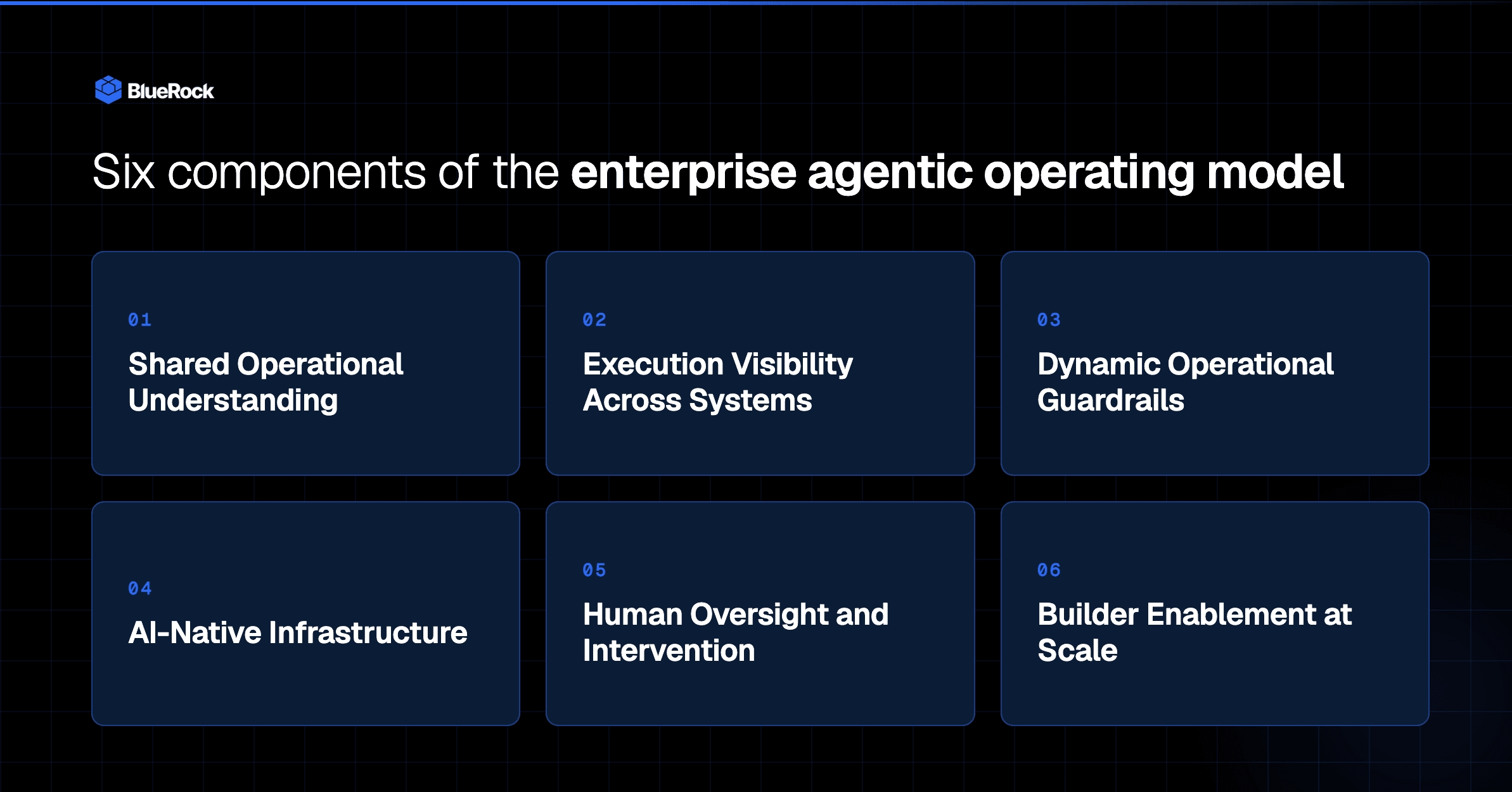
The Core Components of an Enterprise Agentic Operating Model
The next generation of enterprise operations will increasingly require a shared operating model designed specifically for autonomous systems and AI-native builders.
Several capabilities are beginning to emerge as foundational.
1. Shared Operational Understanding
Engineering, security, platform, and business teams need a common understanding of how autonomous systems behave across the organization.
Fragmented visibility across disconnected tools and teams becomes increasingly difficult once execution spans models, agents, APIs, workflows, and downstream systems simultaneously.
2. Execution Visibility Across Systems
Organizations need the ability to understand how autonomous workflows evolve across tools, infrastructure, and environments as execution unfolds.
Traditional request-level telemetry is no longer enough for continuously active systems operating across distributed workflows.
3. Dynamic Operational Guardrails
Static approvals and pre-deployment reviews cannot keep pace with autonomous execution.
Controls increasingly need to evolve toward adaptive operational guardrails capable of responding dynamically as systems execute.
4. AI-Native Infrastructure
The infrastructure supporting AI-native builders must evolve alongside the workloads themselves.
Long-running agents, distributed workflows, ephemeral environments, and continuously active systems create operational requirements very different from traditional enterprise applications.
5. Human Oversight and Intervention
Humans are increasingly shifting from direct operators into supervisory roles.
The future operating model is not humans manually performing every task. It is humans guiding, supervising, and intervening across increasingly autonomous systems.
6. Builder Enablement at Enterprise Scale
The organizations that succeed will optimize for builder velocity, not restrict it.
The goal is not slowing AI-native builders down. It is creating operational systems capable of supporting rapid experimentation and distributed software creation safely at scale.
The Enterprise Is Entering a New Operational Era
The rise of AI-native builders is not temporary experimentation.
It represents the beginning of a new enterprise operating model where software creation, execution, and operations become increasingly autonomous, distributed, and continuous.
The organizations that succeed will be the ones that learn how to enable that shift without slowing the builders driving it forward.
FAQ
What is an agentic operating model?
An agentic operating model is an enterprise framework designed for autonomous, continuously active AI systems rather than static applications. It replaces pre-deployment approvals and centralized control with shared operational visibility, dynamic guardrails, and human supervisory oversight — enabling AI-native builders to move quickly without losing organizational understanding of how systems behave.
Why do traditional enterprise operating models fail with AI agents?
Traditional enterprise models assume slow software change cycles, centralized developers, predictable execution paths, and governance that happens before deployment. Autonomous agents break all four assumptions simultaneously — they execute dynamically across tools and environments, are built by distributed teams including non-engineers, and evolve continuously after deployment. Governance that happens before execution can't keep pace.
How does agentic AI change who builds software in the enterprise?
AI-native tools like GitHub Copilot, Cursor, and Claude Code have expanded software creation well beyond engineering teams. RevOps teams build lead-routing workflows, customer success teams deploy automations, and analysts generate internal tools — often without traditional engineering involvement. GitHub Copilot alone has surpassed 20 million users and is deployed across roughly 90% of the Fortune 100.
Can enterprises slow down AI-native builders to maintain control?
Practically, no — and attempting to do so creates a different risk. Organizations that impose heavier approvals and slower review cycles to preserve older control models will find that innovation moves around them rather than through them. The viable path is building operational systems that provide visibility and dynamic guardrails without restricting builder velocity. Enablement at scale, not restriction, is the competitive differentiator.
What's the difference between execution visibility and traditional telemetry?
Traditional telemetry captures discrete requests and responses — it was designed for applications with predictable, bounded execution paths. Execution visibility for agentic systems means tracking how autonomous workflows evolve across models, APIs, tools, and downstream systems as they run. It requires understanding chains of action, not just individual events, because agents make decisions mid-execution that traditional logging never anticipated.
