

5 min read
The Rise of the Citizen Developer: Why the Fastest Builders Aren’t in Engineering
David Greenberg
Chief Marketing Officer
Something fundamental has shifted in how software gets built inside companies. And it didn’t happen inside engineering.
It’s happening in sales, marketing, operations, finance. It’s happening in the places closest to revenue, customers, and day-to-day execution. And it’s happening faster than most organizations realize.
A new class of builder has emerged: often referred to as the “citizen developer,” the “GTM developer,” or more recently, the “vibe coder.” The label matters less than the reality: people who were never formally trained as engineers are now building real systems that automate workflows, interact with customers, and increasingly make decisions on behalf of the business.
This is not a fringe trend. It is becoming one of the most important shifts in how work gets done.
From Interfaces to Instructions
For decades, software development required specialized knowledge. You needed to understand syntax, frameworks, and infrastructure. Even with the rise of web and mobile development (which dramatically expanded access) there was still a steep learning curve.
That barrier has now collapsed.
Modern AI tools have changed the interface from code to instruction. Instead of writing functions, people describe intent. Instead of wiring systems together manually, they orchestrate tools, APIs, and data sources through natural language.
Tools like ChatGPT, Claude, and Cursor have accelerated this shift. In many teams, it is now common to see non-engineers generating working code, building internal tools, or automating workflows in minutes.
This is not just anecdotal. An old (cough, cough) 2024 GitHub study found that over 50% of developers now use AI-assisted coding tools regularly, with measurable improvements in speed and task completion¹. Separately, McKinsey estimates that generative AI could automate 60–70% of current work activities across occupations, particularly in knowledge work².
The trend is clear: the act of building is becoming more accessible, faster, and less constrained by traditional roles.
The Builders Are Closer to the Problem
The most important implication is not just speed. It is proximity.
The people building these systems are often the ones who understand the problem best. A sales operations manager can build an enrichment workflow tailored to their pipeline. A growth team member can create outbound automation tuned to real campaign performance. A customer success lead can prototype tools that directly reflect how customers behave.
This proximity collapses the gap between idea and execution.
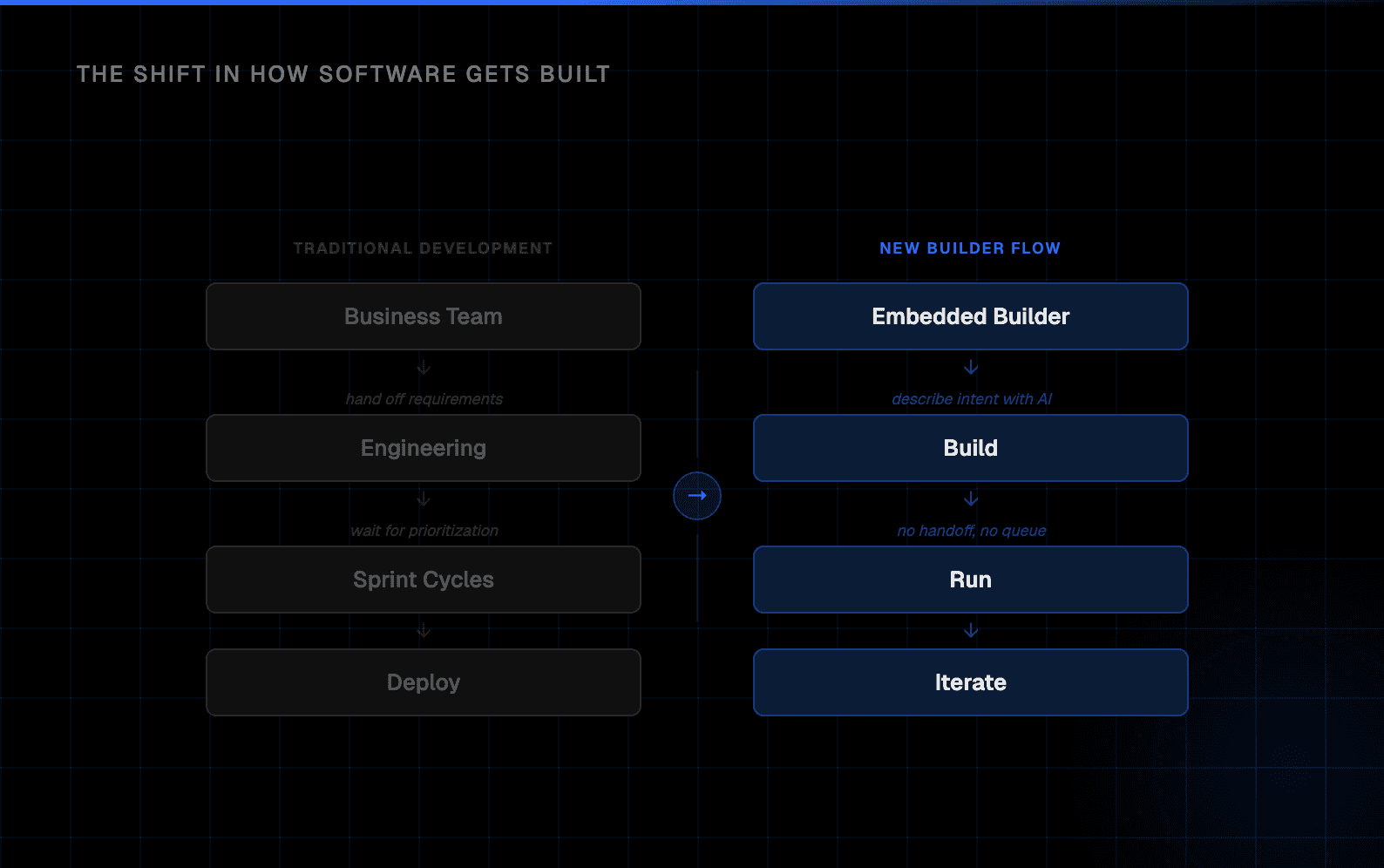
Historically, that gap created friction. Business teams would define requirements, hand them to engineering, wait for prioritization, and then iterate through cycles of feedback. Now, that loop is often bypassed entirely.
The result is a new kind of velocity—one that doesn’t just accelerate development, but shifts who builds and how decisions get executed. And once that shift happens, it doesn’t reverse. Organizations that embrace it move faster than their processes can keep up. Those that don’t will find themselves outpaced by teams already building from within.
What They’re Actually Building
At first, citizen builders focused on lightweight automation. Connecting tools. Moving data. Reducing manual work.
That is no longer the case.
Today, many are building systems that look much closer to software than automation. These include:
Lead enrichment pipelines that pull from multiple sources and adapt based on data quality
Outbound systems that generate messaging, test variations, and iterate based on response
Internal copilots that assist teams with decision-making or content generation
Agent-driven workflows that interact with APIs, tools, and databases in real time
This aligns with broader industry data: Gartner predicts that by end of 2026, 80% of technology products and services will be built by people outside traditional IT roles³.
These are not static scripts. They are systems that operate, adapt, and evolve.
And importantly, they are often built without formal engineering oversight.
The Scale of the Shift
To understand how quickly this is happening, consider the broader context.
Web development expanded the number of people who could build software. Mobile expanded it further. Low-code and no-code platforms lowered the barrier again.
AI has changed the curve entirely.
Instead of requiring people to learn tools, the tools now adapt to the user. The interface is no longer technical—it is conversational. That shift dramatically increases the number of people who can participate.
It also changes expectations. When someone can build a working prototype in minutes, the tolerance for waiting weeks or months disappears.
This is why the growth feels sudden. It is not just that more people are building—it is that they can build faster than the organization can adapt.
The Emerging Reality Inside Companies
Inside most companies, this shift is already underway.
There are dozens (sometimes hundreds) of small systems being created by non-engineers. Some are highly effective. Some are experimental. Many are invisible outside the team that built them.
They are often connected to critical workflows:
revenue generation
customer interaction
internal operations
And they are increasingly powered by agents that make decisions at runtime. This is where the nature of the shift becomes more complex.
Because while the barrier to building has dropped, the complexity of what is being built has increased.
What Comes Next
The rise of the citizen developer is not a temporary phase. It is a structural change in how organizations operate. More people will build. More systems will be created outside traditional engineering. And more of those systems will move from simple automation to dynamic, agent-driven execution.
The question is no longer whether this will happen. It already is.
The real question is what happens next—when these systems are no longer just experiments, but part of how the business runs. That is where things begin to change. It's the question we're focused on at BlueRock: what happens to visibility and control when these systems stop being experiments and start running the business.
Closing Thought
The fastest-growing development team in your company is not sitting in engineering.
It is already embedded in the business.
And it is just getting started.
Sources
¹ GitHub Copilot Research (2023–2024): AI-assisted development adoption and productivity gains
² McKinsey & Company, “The Economic Potential of Generative AI” (2023)
³ Gartner Forecast on citizen developers and non-IT software creation (2024–2026 projections)
FAQ
What is a citizen developer?
A citizen developer is someone without formal engineering training who builds software, automations, or agent-driven workflows using modern AI tools. They're typically embedded in business teams—sales, marketing, operations—and build systems directly connected to revenue and customer workflows.
How have AI tools changed who can build software?
AI tools have shifted the interface from code to natural language. Instead of writing functions or wiring systems manually, business users describe intent and orchestrate tools through conversation. This has collapsed barriers that previously required years of technical training.
What kinds of systems are citizen developers building today?
Beyond simple automation, citizen developers are now building lead enrichment pipelines, outbound messaging systems, internal copilots, and agent-driven workflows that interact with APIs and databases in real time. These are operational systems, not experiments.
What happens when agent-driven systems built outside engineering become operational infrastructure?
As citizen-built systems move from experiments to production, the complexity increases—agents making real-time decisions, interacting with APIs, accessing data at runtime. That's when the need for visibility into what these systems are actually doing becomes critical.
Why is proximity to the problem a competitive advantage for citizen developers?
When the person building a system is also the one who understands the problem, the gap between idea and execution collapses. There's no requirements handoff, no prioritization queue, no feedback cycle through engineering. The result is faster iteration tuned directly to business reality.
