

Why Prompt Tracing Isn't Enough for Agentic Systems
Linda Vu Nguyen
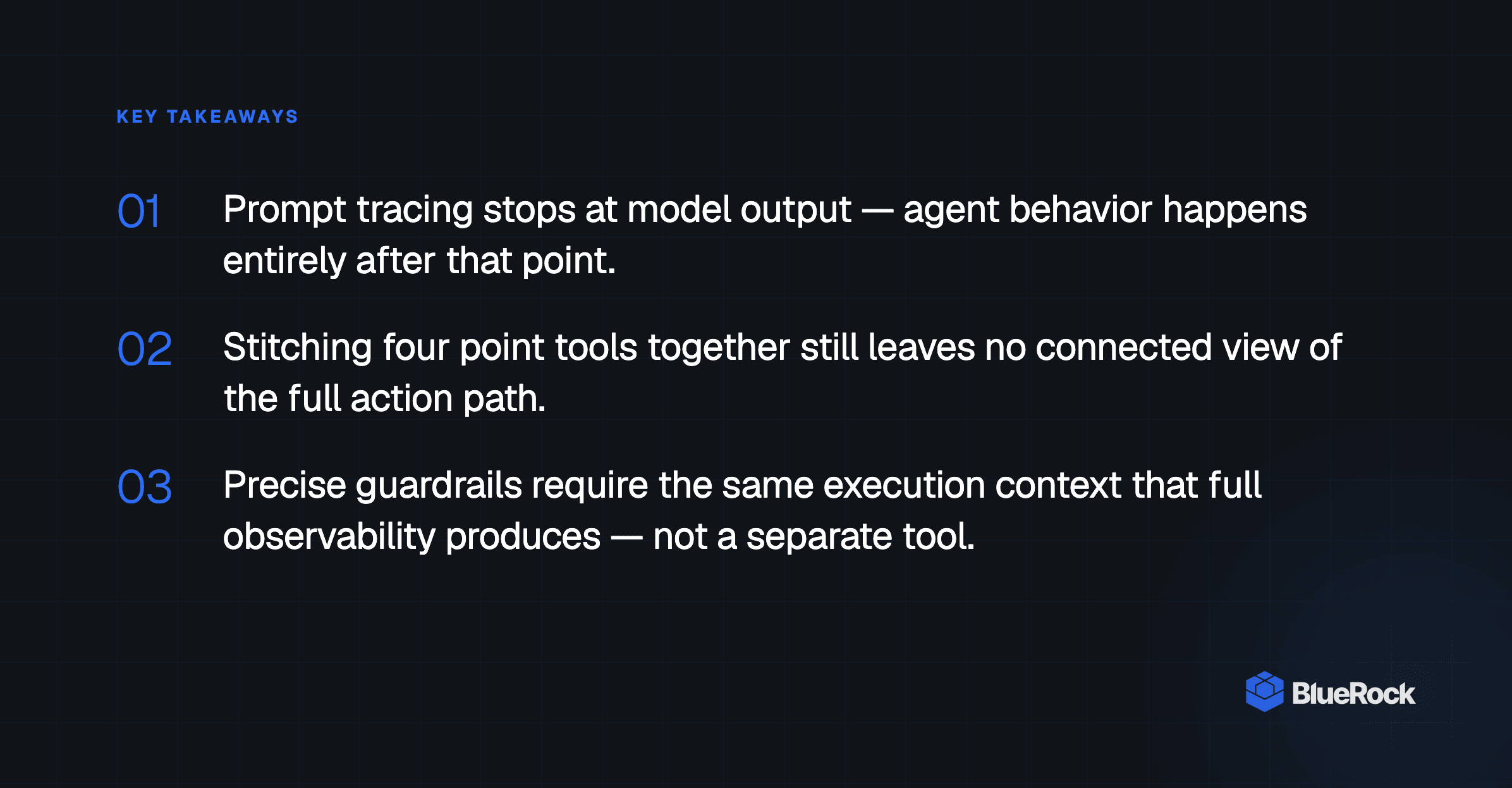
Prompt tracing tools like Langfuse and LangSmith show you what the model said: inputs, outputs, prompt versions, and token costs. They do not show what the agent did: the tool calls, data access, code execution, and downstream effects that happen after the model responds. For agentic systems, that second part is where the outcome is decided, and where most incidents happen. No single point tool covers it.
What prompt tracing covers, and where it stops
Prompt tracing is a real and useful discipline. Langfuse and LangSmith do it well: they trace model inputs and outputs, version and compare prompts, run evaluations, track token cost and latency, and (in Langfuse's case) offer open-source self-hosting. If your job is improving model quality, that is the right tool.
But prompt tracing observes one layer: the model. It stops at the moment the model produces a response. Everything the agent does next is outside its view.
The agent acts after the model responds
An agent does not stop at the model output. It interprets that output and acts. It selects tools, invokes MCP servers, reads and writes data, executes code, and hands off to other agents. This is the Agentic Action Path:
Prompt tracing covers the first step. The remaining steps are where behavior is actually shaped at the app runtime, and where the Agentic Execution Gap lives: teams can see the prompt and the final answer, but not the tool parameters, the data accessed, the code executed, or the downstream effect.
The Fragmented Tool Tax
The instinct is to fill the gap with more point tools. Add a gateway for tool requests. Add a sandbox for isolated execution. Add traditional observability for infrastructure. Each tool sees one fragment of the path:
Layer | Example tools | What it sees | What it misses |
|---|---|---|---|
Prompt tracing | Langfuse, LangSmith | LLM inputs/outputs, prompt versions, evals | Tool execution, data access, code execution, downstream effects |
Gateways | MCP / API gateways | Tool-call requests at the boundary | Data access patterns, code execution, chained behavior |
Sandboxes | Agent sandboxes | Isolated execution | Cross-agent paths, production behavior |
Traditional observability | Datadog, New Relic | Metrics, logs, traces | Agentic action semantics, emergent decision paths |
BlueRock | — | Full Agentic Action Path, plus runtime control | — |
Stitch the first four together and you have paid the Fragmented Tool Tax: four tools, four bills, four integrations to maintain. And you still have no connected view of the action path (each tool's data lives in its own silo, with no durable identifier linking model decision to downstream impact) and no runtime enforcement. You can explain fragments after the fact. You cannot see the whole, or act before something happens.
What this looks like in practice
You've got Datadog. You've got LangSmith. You've got a gateway. You think you're covered. Then an agent exports PII to an unencrypted temp file and nobody catches it.
Picture an agent asked to generate a customer report. Here is what each layer sees:
The first three layers mark this run successful. BlueRock shows you the agent just exported PII to an unencrypted temp file: a pattern you would want to catch, investigate, and block. That is the difference between a green dashboard and knowing what actually happened.
What's still missing even with all of them
Two things no amount of stitching produces:
A connected path. The tools each hold a slice. Without a durable agent identifier that persists across model decision, tool calls, MCP interactions, data access, and execution, you are joining logs by hand to reconstruct what happened. That is the difference between a collection of events and a coherent record.
Control. Observability explains what happened. It does not constrain. Guardrails constrain, but only precisely when they run with full execution context. Prompt tracing, gateways, and traditional observability are all read-only by design: they tell you about a problem after it occurred.
This is the gap between visibility and the boilerplate's actual promise: visibility, understanding, and control.
One operational layer instead of a stitched stack
BlueRock is an agentic operations platform. It provides observability and runtime guardrails across the full Agentic Action Path, from model through MCP servers, data access, and code execution to outcome, powered by the Trust Context Engine.
The Trust Context Engine enriches every step with identity, trust attributes, and operational signals, and maintains a durable agent identifier that connects the path end to end. That is what turns four fragmented tools into one connected record, and what lets guardrails act with enough context to be precise.
A prompt tracer sees the model tokens. A gateway sees that a tool was called. BlueRock sees the actual query, the data it touched, and the downstream effect, connected to the agent that did it. The difference is the path, and the ability to act on it.
In practice: Observability reduces manual log correlation by 90%+ and isolates root cause in seconds rather than hours; Guardrails apply pre-execution enforcement with under 5ms latency overhead, blocking privilege escalation and SSRF at the MCP layer.
Which fits when
This is not a knock on prompt tracing. It is a question of layer and scope.
Prompt tracing (Langfuse, LangSmith) is the right tool when:
You are tuning prompts and measuring model output quality.
Your concern is LLM cost, latency, and response accuracy.
Your system is prompt-in, text-out, without significant tool use or downstream execution.
An agentic operations platform is what you need when:
Your agents call tools, access real data, or execute code in production.
You need to answer "what did the agent actually do, and what did it affect?"
You need to act, not just observe: pre-execution guardrails, not post-hoc log review.
You are operating multi-agent systems where action paths compound, and you do not want to pay the Fragmented Tool Tax to see them.
For the category this sits in, see what an agent observability platform is. For why gateway-level controls fall short specifically, see why gateways can't secure agentic AI and the technical limitations of MCP gateways.
The shift
Code defines intent. Runtime defines behavior. Prompt tracing helps you get the model's intent right. But behavior is shaped across the whole action path, at the app runtime, after the model responds. Seeing and governing that path is a different job than tracing prompts, and it is the job an agentic operations platform exists to do.
FAQ
Why isn't prompt tracing enough for AI agents?
Prompt tracing captures the LLM layer: model inputs, outputs, prompt versions, and token costs. But an agent acts after the model responds — it calls tools, invokes MCP servers, accesses data, executes code, and produces downstream effects. None of that appears in a prompt trace. For agentic systems, the part that determines the outcome, and where most incidents happen, is exactly the part prompt tracing does not see.
What is the Fragmented Tool Tax?
The Fragmented Tool Tax is the cost of stitching together point tools to approximate full agent visibility and control: prompt tracing for the model layer, a gateway for tool requests, a sandbox for isolated execution, and traditional observability for infrastructure. Each sees one fragment of the action path. You pay in integration work, overlapping bills, and gaps between tools — and you still have no connected view of what the agent actually did, and no runtime enforcement before something goes wrong.
Is Langfuse enough for agentic systems in production?
Langfuse is a strong open-source LLM observability platform — tracing, prompt management, evaluations, and self-hosting. It is the right tool for improving model quality. It is not designed to observe what the agent does after the model responds: tool execution, data access, code execution, and cross-agent behavior. For agents acting in production, you also need full Agentic Action Path visibility and runtime guardrails, which is a different layer than prompt tracing.
What does an agentic operations platform cover that point tools don't?
It covers the full Agentic Action Path as one connected record — model, agent, MCP, data, execution, outcome — with a durable agent identifier that persists across every step. Point tools each see a fragment and cannot connect the path or act on it. An agentic operations platform adds runtime guardrails for pre-execution enforcement, turning four fragmented tools into one coherent record with the ability to act, not just observe.
Do I need separate tools for agent observability and guardrails?
Not if they share execution context. Observability explains what an agent did; guardrails act before it does something harmful. Guardrails are only precise when they run with the same execution context that observability produces — otherwise rules are too broad or too narrow. An agentic operations platform provides both across the full action path from one layer, rather than as two stitched-together tools with a gap between them.
