

5 minutes
How Cursor Is Expanding Who Can Build Software
David Greenberg
Chief Marketing Officer
For decades, software creation was largely constrained by one resource: engineering capacity.
Organizations could only build as much software as their engineering teams had the time, expertise, and resources to deliver. New ideas competed for limited development cycles. Internal tools accumulated in backlogs. Automation opportunities were often deferred because the business case could not justify dedicated engineering effort.
That equation is beginning to change.
Cursor is often described as an AI coding assistant, but that characterization understates what is happening.

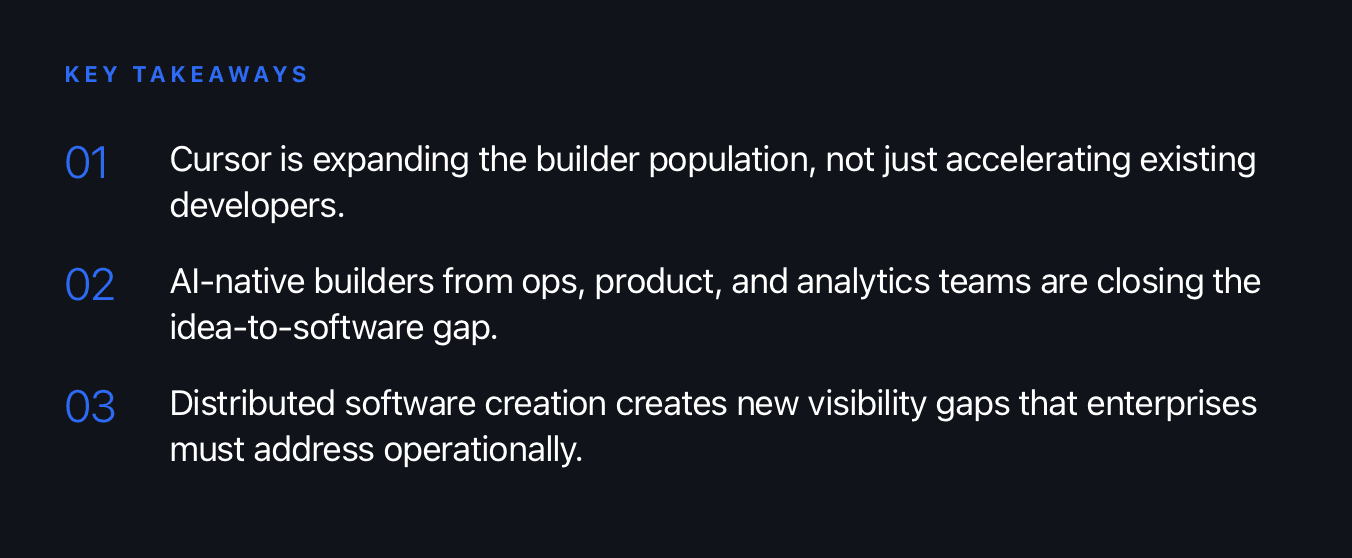
The more important shift is that Cursor is making software creation accessible to a much larger population of builders.
Engineers are becoming dramatically more productive.
At the same time, technically capable product managers, operations leaders, analysts, and domain experts are increasingly able to create workflows, automations, internal applications, and integrations that previously required dedicated development resources.
The result is not simply faster software development.
It is a larger software-building population.
The Rise Of the AI-Native Builder
Much of the conversation around AI development tools focuses on engineering productivity.
That matters.
But the larger trend may be the emergence of AI-native builders. These individuals are not necessarily professional software engineers.
They are people who understand business problems deeply and can increasingly use AI-assisted development environments to translate ideas into working software.
For organizations, this changes several long-standing assumptions.
A growing percentage of software creation may originate from:
Product teams
Revenue operations teams
Marketing organizations
Security teams
Business analysts
Technical domain experts
The historical gap between identifying a problem and creating a solution is narrowing.
What previously required formal development projects can increasingly begin with an individual builder working directly inside an AI-powered development environment.
Cursor Is Changing The Economics Of Software Creation
The significance of Cursor is not that developers can generate code faster. Development tools have promised productivity gains for years.
The more meaningful shift is that AI changes the relationship between expertise and output.
Builders spend less time learning implementation details, navigating documentation, or manually assembling code.
They spend more time defining objectives, evaluating outcomes, and refining solutions.
This changes what small teams can accomplish. It also changes what individual contributors can accomplish.
Projects that once required specialized development resources can increasingly be initiated, tested, and delivered by people much closer to the business problem itself.
For enterprise leaders, that creates a new source of leverage.
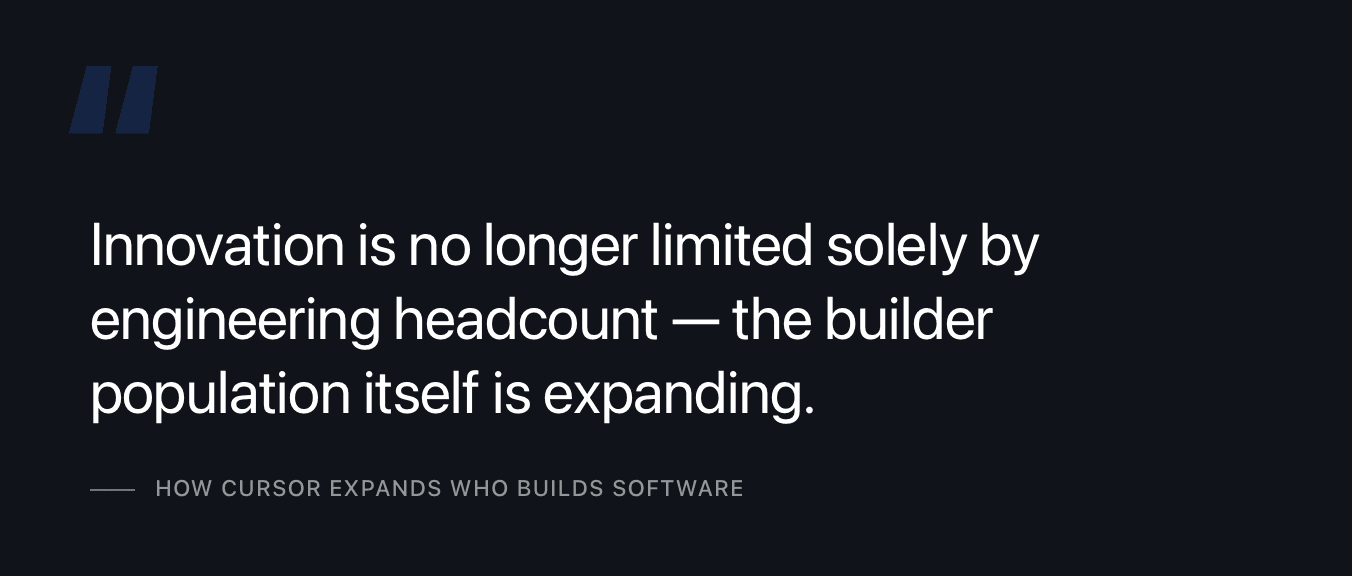
Innovation is no longer limited solely by engineering headcount.
The IDE Is Becoming The Primary Creation Environment
One of the most overlooked aspects of Cursor's growth is how dramatically it changes the role of the development environment.
Historically, the IDE was where code was written. Increasingly, it is where software is conceived, designed, built, tested, and refined.
Requirements are discussed inside the IDE. Architectural decisions are explored through conversation. Code is generated and modified continuously. AI systems participate throughout the creation process.
The IDE is no longer simply a coding tool. It is becoming the primary interface through which software is created.
As a result, more of the software creation lifecycle is moving into environments that enterprises have historically treated as individual productivity tools rather than strategic platforms.
That distinction is becoming increasingly important.
The Enterprise Opportunity Is Bigger Than Productivity
Organizations often evaluate Cursor through the lens of developer efficiency. That is understandable. The productivity gains are real.
But focusing exclusively on developer productivity risks missing the larger opportunity. Cursor enables organizations to expand the number of people capable of building.
The impact is not limited to software teams.
It extends to every department that has ideas, workflows, data, and processes that can be improved through software.
In many organizations, the next generation of builders may not come from engineering at all.
They may emerge from the business itself.
The Next Challenge Is Already Emerging
As AI-native builders become more common, organizations are beginning to encounter a new set of questions.
How was this application created?
Which AI systems participated?
What tools, data sources, and services were involved?
Who approved the resulting changes?
How do organizations maintain visibility as software creation expands beyond traditional engineering teams?
These questions become more important as software creation becomes more distributed, more autonomous, and more accessible.
Because while Cursor is helping more people build software than ever before, understanding how that software is created may become just as important as the software itself.
FAQ
What is an AI-native builder?
An AI-native builder is someone who is not a professional software engineer but uses AI-assisted development environments like Cursor to translate business problems into working software. This includes product managers, operations leaders, analysts, and domain experts who can now create workflows, automations, and internal applications without dedicated engineering support.
How does Cursor change the economics of software creation?
Cursor shifts the relationship between expertise and output. Builders spend less time on implementation details and documentation, and more time defining objectives and refining solutions. Projects that previously required specialized development resources can increasingly be initiated and delivered by people closer to the business problem itself, reducing dependence on engineering headcount.
Why does it matter that more people can build software?
When software creation expands beyond engineering teams, organizations gain a new source of leverage — innovation is no longer bottlenecked by development capacity. Every department with ideas, workflows, and data becomes a potential source of software creation. The historical gap between identifying a problem and building a solution narrows significantly.
What's the difference between developer productivity gains and expanding the builder population?
Developer productivity gains mean existing engineers ship faster. Expanding the builder population means a fundamentally larger group of people — product, ops, marketing, analytics — can create software at all. The first is an efficiency improvement; the second is a structural shift in where software originates inside an organization.
What operational challenges emerge when more people build software?
As software creation becomes more distributed, organizations face new visibility gaps: which AI systems participated in building a given application, what tools and data sources were involved, who approved the resulting changes, and how outputs are governed. These questions become harder to answer when creation happens outside traditional engineering workflows.
Cursor is not simply another developer productivity tool. It is reshaping how software is created, who creates it, and how engineering organizations operate.
