

3 minutes
Agent Observability Platform: What It Is and How It Works
Linda Vu Nguyen
An agent observability platform is software that traces, monitors, evaluates, and explains what AI agents do in production: the tool calls they make, the data they access, the code they run, and the outcomes they produce. It answers the question every engineering and security team reaches once agents are in production: "what did my agent actually do, and why?"
Why agent behavior needs dedicated observability
Traditional software behaves the way it is written. You can read the code and predict the execution path. Agents do not work that way. They interpret context, select tools, access data, and decide what to do next at the app runtime. Behavior is shaped dynamically, not predetermined.
This structural difference has a direct consequence: the tools that work for deterministic software do not answer the right questions for agent-driven systems.
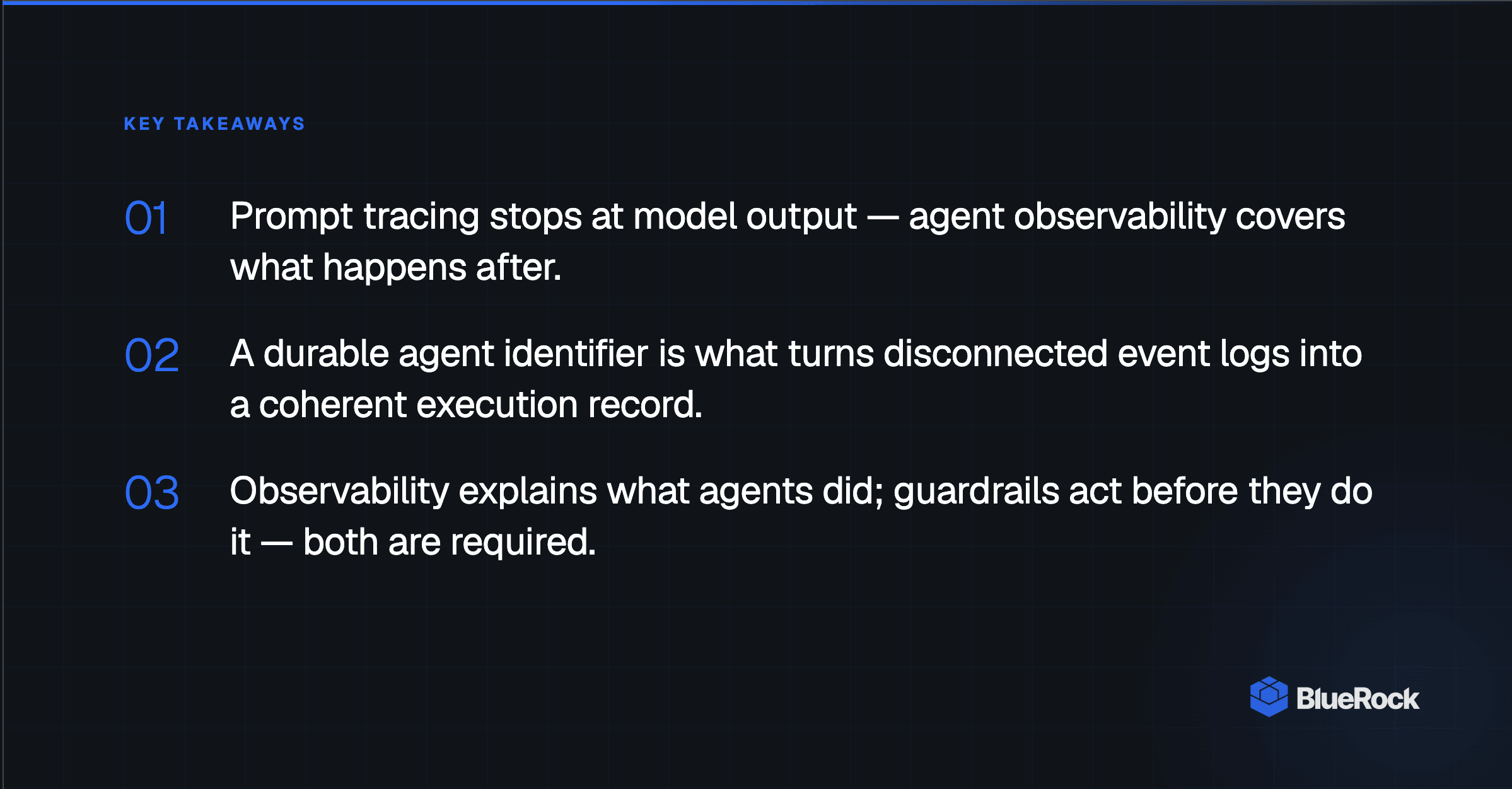
Application performance monitoring (Datadog, New Relic, Grafana) was built to observe infrastructure flows, request latencies, and error rates, not emergent agent decision paths. Prompt tracing tools (LangSmith, Langfuse) capture model inputs and outputs but stop before the agent acts on them. Gateways inspect tool call requests at one boundary. None of these, individually or combined, produce a coherent picture of what the agent did between receiving a task and producing an outcome.
The gap between what tools produce and what agents actually do is the Agentic Execution Gap: runtime behavior accelerates while visibility remains fragmented.
What an agent observability platform includes
The core capabilities span four functions.
Tracing
Tracing records the sequence of actions an agent took: which tools it called, with what parameters, in what order, and with what results. Useful tracing extends beyond the LLM layer to cover the full Agentic Action Path: model decision → agent → MCP server → data access → code execution → outcome. It also requires identity persistence. Without a durable agent identifier that carries through every step, you cannot connect a model output to its downstream impact. You get a collection of events, not a coherent path.
Evals
Evaluation lets teams systematically test whether agents behave as intended: correctness testing (did the agent produce the right output?), safety testing (did it stay within expected boundaries?), and regression testing (did a model or prompt change alter behavior?). Evals range from simple pass/fail assertions to human review workflows and LLM-as-judge scoring.
Monitoring
Monitoring surfaces production behavior continuously: success rates, latency by step, error frequency, cost per run, and behavioral drift over time. For agent-driven systems, monitoring needs to track action-level signals, not just request-level metrics, because the same tool call can have very different downstream consequences depending on parameters and context.
Guardrails
Guardrails are the enforcement counterpart to observability. Where observability explains what happened, Guardrails act before it happens: blocking actions that violate policy, escalating for human review, or enforcing access constraints at the app runtime. Context-aware guardrails require the same execution context that observability produces. Without knowing what the agent is doing and why, guardrail rules become either too broad (blocking legitimate actions) or too narrow (missing real risks).
The principle worth anchoring: observability explains, it does not constrain. Guardrails constrain. The two capabilities are complementary, not interchangeable.
How agent observability platforms differ
Not all agent observability platforms observe at the same depth. The meaningful distinction is where in the agent action path observation stops.
Capability layer | Prompt tracing (Langfuse, LangSmith, Arize) | Traditional observability (Datadog, New Relic) | Full-path observability (BlueRock) |
|---|---|---|---|
LLM inputs/outputs | Yes | Partial (via log shipping) | Yes |
Token usage and cost tracking | Yes | No | Yes |
Tool call names | Yes (via instrumentation) | Partial | Yes |
Tool call parameters and arguments | Limited | No | Yes |
MCP server interactions | Not natively | No | Yes |
Data access paths | No | Partial (service-level) | Yes |
Code execution details | No | Partial (infra metrics) | Yes |
Cross-agent action chains | No | No | Yes |
Runtime enforcement (guardrails) | No | No | Yes |
Durable agent identifier across chain | No | No | Yes |
The distinction between the first column and the third is not a feature difference, it is an architectural one. Prompt tracing tools were designed to help ML engineers improve model quality. They answer "what did the model say?" They were not built to answer "what did the agent do after that?"
Traditional observability platforms were built for deterministic software. They observe infrastructure flows and request lifecycles well. They are not built to observe emergent decision paths where the same input can produce different execution graphs depending on context.
This is not a criticism of any of those tools. Each does what it was designed to do. The question is whether what it was designed to do is sufficient for your use case.
The full agent action path: model to outcome
The Agentic Action Path is the sequence from model decision through agent behavior, MCP tool calls, data access, and code execution, to outcome. This is what the agent actually did.
Most agent observability platforms cover the left end of this chain well and trail off toward the right. Coverage of MCP server interactions, data access patterns, and code execution varies significantly across the landscape.
The case for full-path observability is direct: if you cannot observe what happened at each step, you cannot explain a production failure, prove an agent stayed within bounds, or improve its behavior systematically. Partial observability produces partial answers.
Three execution boundaries every agent crosses
Agent actions cross three structural boundaries, each with its own observability and risk profile:
Tools. MCP tool invocations, parameters passed, and chained tool behavior. Risk: calling destructive tools, injection via parameters, shadow MCP servers connected without review.
Data. What data the agent accessed, transformed, or moved. Risk: reading sensitive data outside scope, unauthorized exfiltration, cross-environment access.
Execution. Shell commands, subprocesses, and code operations. Risk: spawning shells, executing unvalidated code, privilege escalation.
Gateways observe at the tools boundary only. Traditional observability observes infrastructure around these boundaries. Full-path observability maps all three.
BlueRock's approach
BlueRock provides Observability and Guardrails across the full Agentic Action Path, from model through MCP servers, data access, and code execution to outcome, powered by the Trust Context Engine.
The Trust Context Engine is the layer that makes full-path observability possible. It continuously enriches execution with identity, trust attributes, and operational signals across agents, tools, MCP servers, and infrastructure. This context is what allows BlueRock to connect a model decision to its downstream impact without losing the thread. The connecting tissue is the durable agent identifier, an ID that persists across every step of the action path. Without it, you have a collection of events from different systems. With it, you have a coherent execution record from model decision to outcome.
What BlueRock observes that prompt tracers do not:
The difference is not cosmetic. The query text is the execution. The model name is not.
BlueRock's Guardrails apply pre-execution enforcement with less than 5ms latency overhead. Because enforcement runs with full execution context from the Trust Context Engine, guardrail rules can be precise: blocking privilege escalation via expansive tool arguments and SSRF attacks at the MCP layer without high false-positive rates.
Production proof points:
Root cause isolation in seconds, not hours
90%+ reduction in manual log correlation
<5ms guardrail enforcement latency overhead
BlueRock fits within the recognized category of agent observability platforms and extends it. The extension is the Trust Context Engine, the durable agent identifier, and runtime Guardrails: the layer between "what the model said" and "what the system did."
For why the prompt-tracing layer alone falls short for agents, see why prompt tracing isn't enough for agentic systems.
Who uses an agent observability platform
AI agent developers use it to debug production failures, catch drift early, and understand what their agents are doing between task assignment and outcome.
DevOps and platform engineering use it to trace the full action path from model decision to production outcome without manually correlating logs across systems.
Product security and AppSec teams use it to discover shadow MCP servers, map agent action paths they did not know existed, and apply enforcement rules with context rather than static pattern matching.
Engineering leaders use it to remove the speed-safety tradeoff: full observability means teams can ship agents to production without choosing between iteration speed and operational confidence.
What to look for in an agent observability platform
Where does tracing stop? Does the platform observe past the LLM layer into tool parameters, MCP interactions, data access, and code execution?
Is there a durable identifier that persists across the full action path, or do you lose the thread at tool handoffs?
Does the platform observe multi-agent chains, or only single-agent traces?
Are guardrails built in, or do you need a separate enforcement layer?
What is the latency overhead of enforcement, and does it scale with production traffic?
Can the platform explain a production incident end-to-end from model decision to outcome without requiring manual correlation across separate tools?
The last question is the most diagnostic. If the answer is "not without pulling logs from three systems and joining them by hand," the platform observes fragments, not the full path.
Further reading
What is the Agentic Execution Gap? — the problem this category exists to solve
What is the Agentic Action Path? — the model-to-outcome chain explained
Why observability matters for agentic systems — deeper architectural context
Why prompt tracing isn't enough for agentic systems — the Fragmented Tool Tax
BlueRock Observability · BlueRock Guardrails · Trust Context Engine
FAQ
What is an agent observability platform?
An agent observability platform traces, monitors, evaluates, and explains what AI agents do in production: the tool calls they make, the data they access, the code they execute, and the outcomes they produce. Unlike application performance monitoring or prompt tracing, it is designed for systems where execution paths emerge dynamically at runtime rather than following predefined code.
How is agent observability different from LLM observability?
LLM observability — as provided by tools like LangSmith and Langfuse — traces model inputs, outputs, token usage, and prompt chains. It answers what the model said. Agent observability traces what the agent did after that: the tool calls it made with their full parameters, the MCP servers it contacted, the data it accessed, and the code it ran. The gap between those two things is the Agentic Execution Gap, and it is where most production failures and operational risks actually occur.
Does an agent observability platform replace tools like Datadog or LangSmith?
No. Traditional observability platforms like Datadog observe infrastructure flows well — request latencies, error rates, resource utilization. Prompt tracing tools like LangSmith observe model behavior well. Neither was designed to trace the full agent action path: model to agent to MCP server to data access to code execution to outcome. An agent observability platform fills the gap between them, with identity and context that persists across the full chain.
What is the difference between agent observability and agent guardrails?
Observability explains what happened. Guardrails act before it happens. Observability traces the full action path, surfaces anomalies, and gives teams the context to understand and improve agent behavior. Guardrails apply pre-execution enforcement — blocking actions that violate policy, preventing privilege escalation, or stopping attacks at the MCP layer before they run. The two are complementary: observability provides the execution context that makes guardrails precise rather than blunt.
What is a durable agent identifier and why does it matter for observability?
A durable agent identifier is an ID that persists across every step of an agent's action path — from the model's initial decision through tool calls, MCP interactions, data access, and code execution to the final outcome. Without it, you have separate event logs from different systems with no reliable way to connect them. With it, you have a coherent execution record that lets you trace from what the model decided to what actually happened in production, and attribute outcomes to specific agent runs.
