

5 min read
Press Release: Introducing the Trust Context Engine
BlueRock
BlueRock Launches Trust Context Engine to Help Developers Move Faster with Trusted Agentic Systems
Powered by the MCP Trust Registry and runtime sensors, shared trust context across the entire Agentic Action Path helps teams make better decisions and move faster into production.
SAN FRANCISCO, CA — April 2, 2026 — BlueRock today announced the Trust Context Engine, a new context layer for the Agentic Action Path that helps teams move faster while making better decisions about how agents interact across tools, MCP servers, and connected components.
Control has shifted from code to runtime — and without visibility into execution, teams can’t fully understand or trust agent behavior. BlueRock shows what agents actually do — and gives teams the trust context to decide what agents should do.
Agentic systems are changing how software behaves. Instead of following predefined code paths, agents interpret context, select tools, and generate execution dynamically at runtime across connected components. Teams must move fast while understanding which components are safe, how they behave, and how decisions propagate.
The Trust Context Engine classifies each action an agent executes — such as what capability was invoked, what component was involved, and what downstream effect occurred — enriching the Agentic Action Path with structured context.
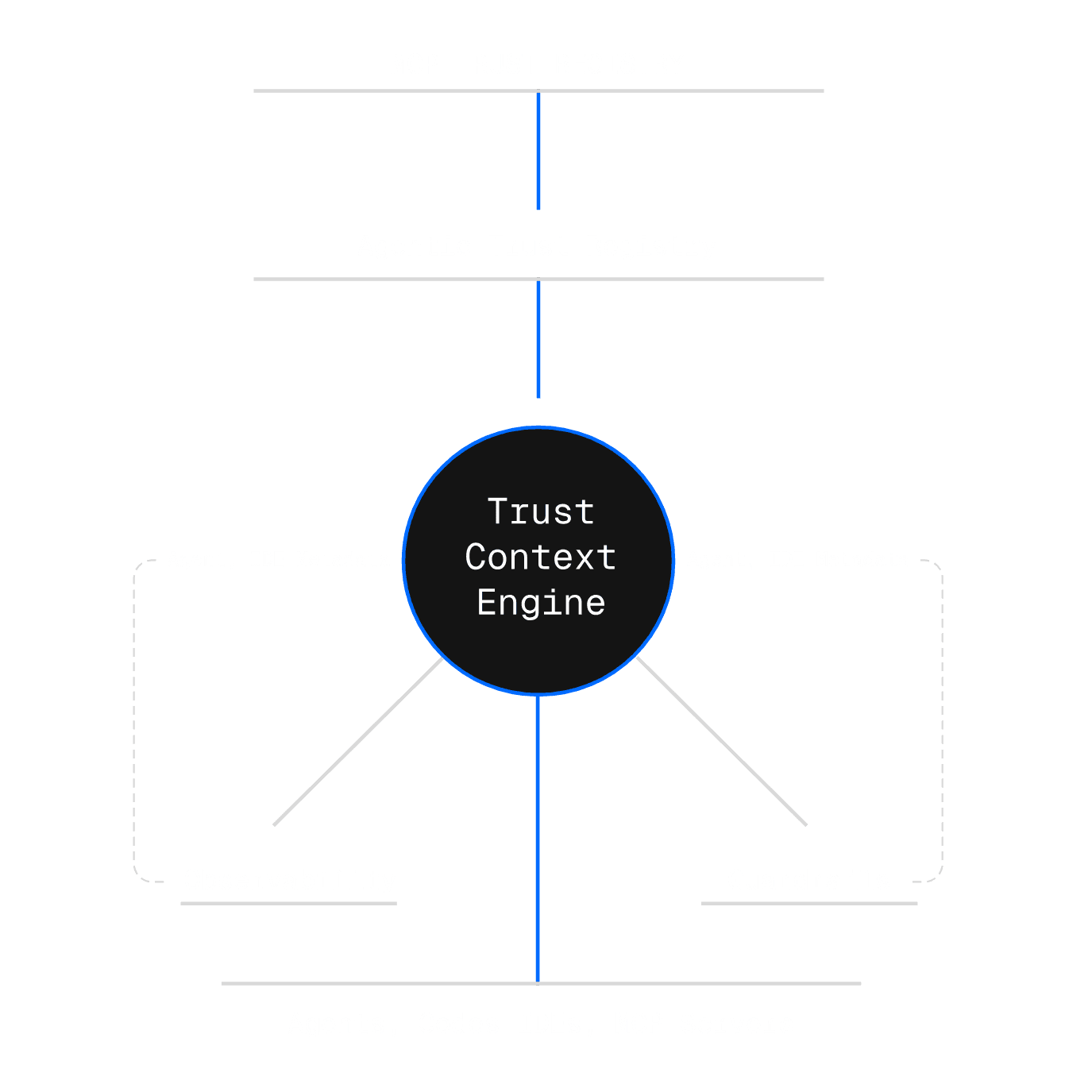
Build, Experiment, and Run Agents on Trusted Components
The Trust Context Engine provides the missing context layer between execution and understanding, attaching trust context for each step of the Agentic Action Path. This trust context includes component metadata, trust signals, and runtime behavior — giving teams the information needed to evaluate what agents are doing and make better decisions about what to run in production.
As agents execute, BlueRock attaches identifiers, tool and capability metadata, MCP server attributes, ownership signals, tool classification, access patterns, and observed runtime behavior to each step — creating a unified end-to-end view of execution.
Teams use the Trust Context Engine to build, validate, and promote agentic workflows with confidence — connecting to trusted MCP servers, observing execution in practice, and deploying only what is verified and appropriate for production. Teams can consume Trust Context signals directly in their workflows, using them to inform automation, approvals, policy decisions, and runtime controls.
This trust context spans the full execution path — from model decision to tool invocation to downstream system impact — giving teams a real-time view of how agent behavior unfolds. Teams can also see which components are trusted and adopted across the ecosystem, helping them decide what to build with, what to allow, and what to run in production.
How teams can use the Trust Context Engine:
Developers: Build agents connected to trusted MCP servers, know which servers and tools are safe to build with. Ship agentic workflows that are validated and ready for others to adopt with confidence.
DevOps and platform teams: Plug Trust Context signals into CI/CD automation to evaluate both MCP servers and agent workflows. Trust Context signals help prioritize high-impact activity and promotion decisions in production.
Security teams: Define trusted components and boundaries, use Trust Context signals to prioritize risk, and feed that context into policy and control workflows before unsafe actions execute.
MCP server builders: Understand how your MCP is rated and used, identify vulnerabilities and exposure, and improve trust posture so more teams can confidently adopt and build with it.
“AI changed how we write software. Agentic systems change how software behaves,” said Bob Tinker, CEO of BlueRock. “Developers want to move fast and consume capabilities, but they also need to understand what they’re connecting to and how those systems behave. The Trust Context Engine gives teams the context to make better decisions and the visibility to operate with confidence.”
Powered by the MCP Trust Registry and Runtime Signals
The Trust Context Engine is now powered by two sources of context: curated MCP trust data from the MCP Trust Registry and real-time execution signals captured by BlueRock sensors.
The MCP Trust Registry gathers MCP trust data across public MCP servers — including capability exposure, ownership signals, tool classification, and trust attributes. At runtime, BlueRock sensors capture additional signals such as tool usage, access patterns, and downstream system impact. Together, these inputs are combined in the Trust Context Engine to create trust context that can be used across development and production workflows.
As agents interact with MCP servers, BlueRock attaches this combined context directly to each interaction. Teams can see which MCP servers are used, what capabilities they expose, and how those capabilities are exercised in real workflows — enriched with both known attributes and observed behavior.
This closed “context loop” approach connects what is known about components with how they actually behave in practice, helping teams make better decisions about what to build with, what to allow, and what to run in production.
“As an agentic AI company, Adspirer powers AI performance marketing agents that plan, launch, and optimize campaigns across Meta, Google, and more,” said Abhi Mekala, CEO of Adspirer. “With thousands of decisions flowing through our MCP infrastructure, our customers expect reliability and security. BlueRock gives us the visibility and control we need to run agentic systems with confidence.”
Start Building with BlueRock
As agentic systems move from experimentation into real workflows, teams need to understand how those workflows behave in production. BlueRock is now available to help teams build, run, and operate agentic workflows with trust context across the full Agentic Action Path.
Developers can get started immediately to run agents in BlueRock, see how execution unfolds, and use that visibility to make better decisions about what to use and what to deploy. Teams can consume Trust Context signals directly in their workflows — enriching how decisions are made across development and production.
BlueRock will be demonstrating these capabilities during the MCP Dev Summit in New York City on April 2–3, 2026.
Teams can get started today at www.bluerock.io to try BlueRock, explore the MCP Trust Registry, and start building with Trust Context.
FAQ
What is the Trust Context Engine?
The Trust Context Engine is BlueRock's core context layer for the Agentic Action Path. It attaches structured trust context to each step of agent execution — including component metadata, trust signals, tool classification, access patterns, and observed runtime behavior — giving teams a unified, end-to-end view of what agents actually do in production.
How does the Trust Context Engine work?
The Trust Context Engine draws from two sources: curated MCP trust data from the MCP Trust Registry (covering 10,000+ public MCP servers analyzed against 22 security rules) and real-time execution signals captured by BlueRock sensors during live agent runs. Together, they form a closed context loop — connecting what is known about components before they run with how they actually behave when they do.
What's the difference between the MCP Trust Registry and the Trust Context Engine?
he MCP Trust Registry is a source of curated trust data about public MCP servers — including capability exposure, ownership signals, vulnerability analysis, and trust attributes. The Trust Context Engine is the layer that combines MCP Trust Registry data with live runtime signals and attaches the resulting context to each step of agent execution across development and production workflows.
How do I get started with the Trust Context Engine?
You can get started at bluerock.io — run agents in BlueRock, see how execution unfolds, and use Trust Context signals to make better decisions about what to use and what to deploy. The MCP Trust Registry is also available to explore the trust posture of public MCP servers before you connect.
Who is the Trust Context Engine designed for?
The Trust Context Engine is useful across the full team building and operating agentic systems: developers who want to build on trusted MCP servers, DevOps and platform teams that need to plug trust signals into CI/CD automation, security teams that need real execution context for policy decisions, and MCP server builders who want visibility into how their servers are used and rated in production.
