
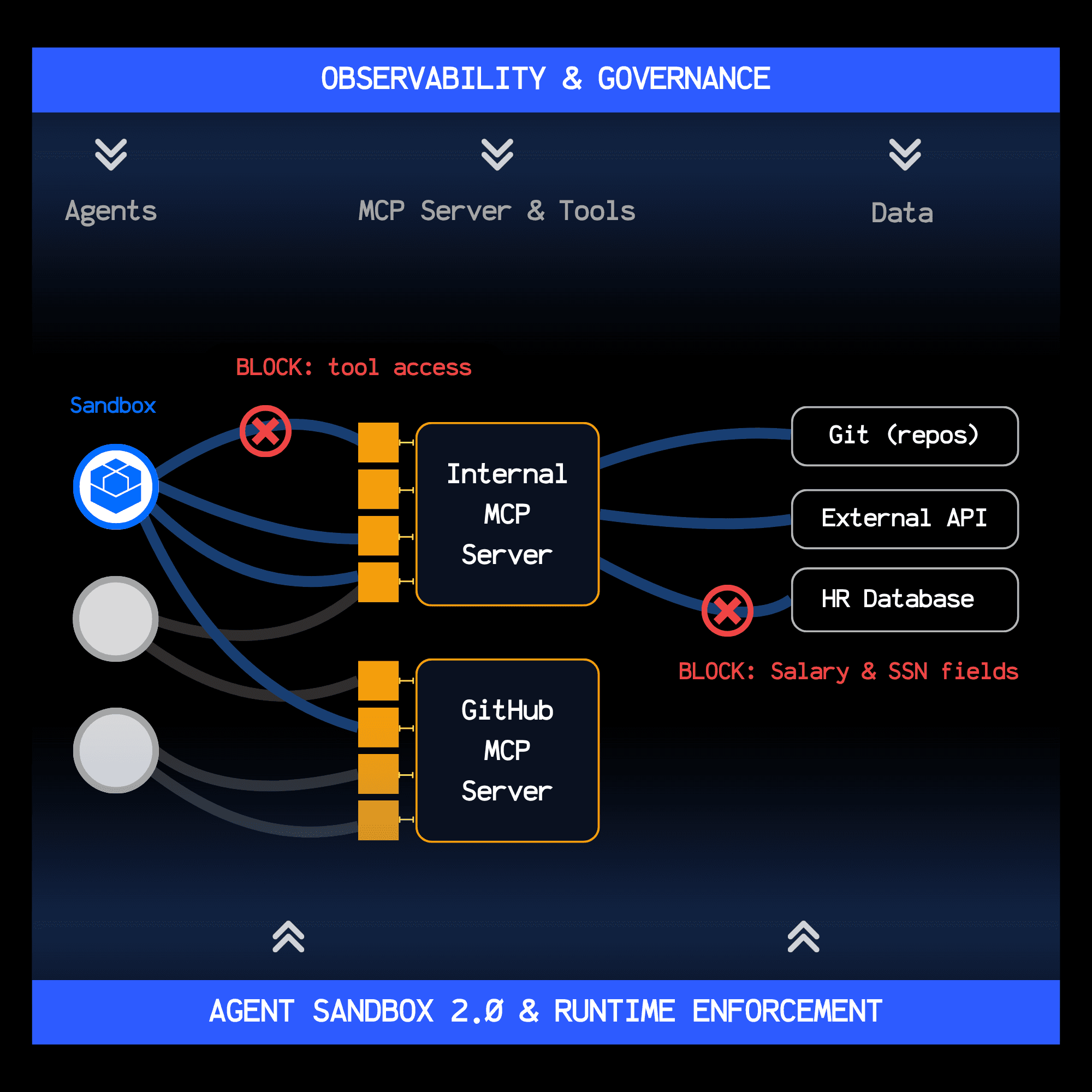
Models generate text — but security risks come from what agents execute.
BlueRock inspects and governs agentic actions across three boundaries:
agent → tool (function calls, parameters, drift)
agent → data (read/write scope, exfil attempts)
agent → code execution (commands, file ops, shells, RCE paths)
Guardrails run before execution, directly in the runtime — stopping unsafe actions even when prompts are manipulated.
Baseline → Guardrails Flow
Baseline
BlueRock learns what “normal” execution looks like for each workflow.
Compare & Drift
You see where behavior deviates: new tools, odd parameters, unusual data access, new processes.
Flip On Guardrails
Once baselined, you can turn on pre-execution guardrails that:
allow
modify
block unsafe actions — before they run.
This is how you prevent prompt-injection-to-execution chains in practice.
The agent may generate malicious text, but BlueRock blocks the harmful action before it runs.
BlueRock MCP Server Protection FAQ
What is MCP Server Protection?
MCP Server Protection provides runtime guardrails across all three agentic boundaries—tools, data, and execution—blocking unsafe actions before they execute. It's the "SECURE" half of BlueRock's "see and secure" approach, enforcing policies at the moment of action where agents and MCP servers actually operate.
How is this different from an AI gateway?
Gateways see requests at the edge. BlueRock sees and secures actions at runtime. Gateways inspect prompts and tool requests (easily bypassed via rephrasing). BlueRock enforces invariant controls at the moment of action—seeing complete action paths across tools, data, and execution. Gateways are external bolt-ons. BlueRock is built into the agent/server runtime.
What are the Three Execution Boundaries?
Every agentic action crosses one of three boundaries: (1) Tools Boundary—agents invoke MCP tools and custom integrations, (2) Data Boundary—agents access, read, transform, and move data, (3) Execution Boundary—agents execute code (shells, subprocesses, file operations). MCP Server Protection provides guardrails at all three boundaries.
What does "pre-execution enforcement" mean?
Pre-execution enforcement stops unsafe actions before they execute—not after damage occurs. When an agent attempts to call a destructive tool, access unauthorized data, or spawn a shell, BlueRock's runtime guardrails stop the action at the moment it's invoked. This prevents incidents rather than detecting them after the fact.
Can I start with visibility only and add enforcement later?
Absolutely. BlueRock's philosophy is "visibility first, control when you're ready." Start with Agentic Visibility to understand agent behavior and baseline patterns, then enable MCP Server Protection guardrails at the specific boundaries where you need enforcement. You can phase enforcement by boundary (tools first, then data, then execution) or by agent workload.